Showing posts with label animal. Show all posts

Thursday, July 9, 2015

Welcome to Jurassic Oz!

About a week before I departed for Australia I went to the movies with my family to see the new “Jurassic World” movie.  If you haven’t seen it yet, I don’t want to ruin it for you.  But I will say that in one scene dozens of giant, flying dinosaurs escape their cage and attack visitors to the theme park.  (Side note: If you have ever worked, or even visited, a Disney park you will undoubtedly recognize that Jurassic World looks eerily similar. Throughout the entire movie I kept reminiscing about my time working at Disney and thinking, “Wow, that job was interesting, but nothing THIS dramatic ever happened.”)

As I was saying, in the movie, giant, flying dinosaurs attack the theme park guests. During this scene, the flying dinos were making a lot of noise; something between the roar of the t-rex (courtesy of Hollywood imagineers) and the squawk of an oversized bird of some sort.

At 5am every morning I wake up in Brisbane, believing I am about to be carried off by a flock of loud, airborne monsters.  Welcome to Jurassic Oz!

One of my favourite things about living in Africa was the animals.  Of course, now I’m exposed to a whole host of different animals, which is exciting.  The difference is, for the most part, the animals in Africa were pretty quiet.  Here, they never shut up.  I was actually in a meeting the other day and the Koels were so loud we could barely hear one another.  Here are the two birds which have made the most significant impression on me thus far:

Here’s the Laughing Kookaburra.  It is actually a very pretty bird, but as you hear, it laughs constantly:

And then here is the Koel.  Keep in mind, in Brisbane these are the most common bird, so you never see just one, you normally see big groups of them (50+):

That’s today’s news for you from Down Under.  I’ll write about some of our other wildlife soon, you know, the kind that can kill you- sharks, jellyfish, spiders, etc.

Thursday, April 2, 2015

Where in the World is Dr. Phelan (Going Next)?

When I first began my blog nearly 18 months ago, my very first blog post was titled: Where in the World is Dr. Phelan? Botswana!

Well, in memory of that first post, I decided to borrow, but also alter, the title.  Rather than asking Where in the World is Dr. Phelan?, the more appropriate question is Where in the World is Dr. Phelan Going Next?  And so we have it….

I will be moving overseas again in a few weeks.  However, this is not a short-term sabbatical move like Botswana.  Instead, this is a more permanent position.  Granted, nothing is really permanent, but this is a full-time position without any pre-determined end date.  Hence, it is considered a permanent move.

Though my future home will be quite different from Africa, and the U.S., there is a lot I’m looking forward to.  Unlike Africa, I’m not expecting excessive power cuts.  But there will be lots of wildlife.  I won’t be the token white person, so I won’t get in trouble for walking with the intent of causing a car accidentBut, there will be a slight language barrier I will need to overcome.  I will need to get a new driver’s license, though since I more or less know how to drive on the “other” side of the road now, I should be able to forego driving lessons.  There is a Little America in my new country, but the necessity of sunscreen will still be strong as ever.

Any guess yet where I might be going?.... 

Want a hint?.... 
In case you didn’t get it the first time, how you could forget?  There are two addresses EVERYONE in the world knows, YOUR address, and….. 

Now, this isn’t entirely accurate.  I’m not moving to Sydney.  But I am moving to Australia!  I recently accepted a position at the University of Queensland, which is in Brisbane, which is here:
I know I said this when I moved to Africa, and only a handful of people took me up on my offer, but I REALLY HOPE YOU’LL COME VISIT ME!

Saturday, March 21, 2015

What to do (and not do) When In… Botswana

Since I returned to the United States in September, I took a new position as the Fulbright Grant Administrator at Texas Tech.  Over the past six months I’ve been busy helping professors write their grant applications, and more recently, I’ve been assisting Fulbright fellowship award winners to prepare for their sabbaticals in their host countries.

Just last week I was speaking to the woman who received a Fulbright grant to Botswana.  We spent over an hour on Skype discussing how to get a research permit, what to expect when it comes to trying to obtain a residency visa or when you go to the doctor’s office for a check-uphow not to get deported, the importance of the headlamp, dating, mating and shopping for real estate, and high-end designer duds at the Dead Muzungu Market (it’s not Louis Vuitton, but it IS an experience).

In addition to aspiring Fulbrighters recognizing my wealth of knowledge about travel in Africa, The Economist recently commissioned me to write an article for inclusion in their lifestyle and culture magazine, Intelligent Life.  Take a look at my article, which recounts what to do (and not do) when visiting Botswana.  If you understand each of these statements it means you read the corresponding blog posts, so thank you for your attention!  Enjoy:


Wednesday, August 20, 2014

Reentering the First World, Part Two

First of all, please let me apologize to my loyal blog readers for being absent for the past week.  I was driving from Maryland back to Texas and stopping to visit friends along the way.  I thought I would keep up with my blog while on the road, but in the end nine hours of driving a day plus mandatory (and necessary) social time with friends I haven’t seen in years equaled an exhausted Kelly unable to open her laptop.  But, rest assured, I am back!

Yesterday I arrived in Lubbock, Texas and was greeted by my posse of graduate students- current and former.  Thank goodness they were here to help me unpack my car, move my things from storage to my new house, rearrange furniture, etc.  They are currently scrubbing the toilets and cutting my lawn as I write this.  Totally kidding!  But they did help me with the move-in process which was a huge relief.  And it was a lot of fun because it was a mini-reunion (mini because we were missing a few Phelantologists who have graduated and moved on to bigger and better things).

I spent the better part of last night and this morning unpacking and cleaning, but you know how moves are.  You unpack 20 boxes only to realize you apparently packed all the plates and utensils, but somehow the glasses and bowls missed the boat.  This is made all the more shocking because somehow there are three used toothbrushes and a half empty roll of toothpaste in a box.  I know, I thought the same thing, Why in the world would I keep those for almost 15 months? Ewwwww….

Around 10 this morning I had a pretty comprehensive list of items I needed to purchase to make my new digs more habitable and so I ventured out to the store.  I know I arrived back in the U.S. about a month ago, but I’ve been so busy with conferences, social visits and family vacations that I haven’t spent any time doing normal day-to-day stuff- like going to the store.  This morning’s visit to Market Street (a grocery store) was a bit overwhelming.  I went in with a list of about a dozen things to buy.  But as I perused the aisles I kept thinking, Oh wow! They have XYZ product?  I should totally get one of those!......  They have ABC!  That’s amazing!  I haven’t seen one of those in…. hmmm…. a year, if not longer.  I definitely need that too…...  I don’t even know what this thing is!  But it looks AWESOME!  I’m totally getting this.  I don’t know what I’m gonna use it for, but I’m pretty sure I will LOVE IT! 

In aisle 8B I realized I had a problem.  Actually it was pointed out to me by Tim, a friendly shelf stocker.  I saw canned artichoke hearts and took EVERY SINGLE can off the shelf.  He stood there and watched me do this and said, “Are you sure you need ALL of those?”  I didn’t count them, but I would guess I had at least 100 cans of artichokes in my cart.  In the end I didn’t buy any of them because I realized I probably wouldn’t eat them this week anyway and I could just wait for them to go on sale.  And when they DO go on sale, they will actually be there.

Last night I was visiting with one of my former grad students and her husband.  Joe asked me, “What was the hardest thing about living in Africa?  What is the biggest adjustment coming home?”  I told him that it’s not the big things that make living abroad hard.  I knew before I went to Africa that there would be lots of power outages, that water rationing might mean you couldn’t take showers for days, that there were food shortages, so there were times you would go to the grocery store and there would be no fresh food on the shelf.  But you expect those things.  The things that drive you nuts are the little things.  Here in the U.S. if you need a battery you go to CVS a block away, run in, pick out the battery you need, pay for it and get out of there.  It should take 5 minutes or less to run that errand.  But that’s not how it works in Africa.  That task could take you all day, or several days.  (Remember when I tried to get my university ID?)

The best example of the little things driving you nuts involved two monkeys, a toothbrush, and what else? A condom.  Because in the end everything (in Africa) involves a condom, right?

One day I was in my house in Botswana, working at my desk on the first floor.  I heard a lot of commotion upstairs and went up to investigate.  Two monkeys had gotten into the house through my open bedroom window and were tearing my bathroom apart.  In the scuffle to get them out of there they knocked my face cream and toothbrush into the toilet.  Now, I wasn’t happy about the face cream because do you have any clue how difficult it is to find face cream for a white person in Africa?  Answer: Very hard.  But I could live without face cream.  I could NOT live without a toothbrush.  I finally got the monkeys out of the house and set out for the store to buy a new toothbrush.  It took me seven hours to (I think) nine or ten different stores in search of a toothbrush.  In the second to the last store I looked around, was unable to find a toothbrush and so I asked for assistance.  The store clerk said they did not have any toothbrushes, but instead offered me a box of condoms.  Though I desperately attempted to keep my cool I failed.  I started flailing my arms and told him, “I CANNOT CLEAN MY TEETH WITH THAT!!!!”  Thinking back on that now I remember the clerk nonchalantly shrugging as if to say, “Hey lady, here’s your option.  If you don’t like it, oh well.”

They say a lot of people who move overseas experience culture shock.  Many individuals also have similar challenges adjusting when they come home.  I suppose the artichokes are my reverse culture shock.  When I was at Market Street today I also stopped to stare at the wall of a thousand toothbrushes.  Sadly, Tim was there for that too.  I thought I was using my inner monologue when I said, “Wow, so many toothbrushes.  They are beautiful.”  But when Tim responded and said, “Yes, we have lots of toothbrushes.  But remember, you can only use one at a time” I thought it best to tell him, “I’m not strange.  I’ve been living in Africa.  I haven’t seen most of this stuff in forever.”  He nodded his head as if he truly understood me and said, “Well, in that case, we are open 24 hours, take your time looking around.” 

Saturday, August 9, 2014

Zonkies: The Cool Kids of the Animal Kingdom

When I went to college I was in one of the first classes to have a significant number of multiracial students.  In an effort to be as transparent as possible I will take this opportunity to admit I actually had to look up the proper term.  A multiracial American is someone who belongs to two or more races.  This is different from being multiethnic.  Most Americans are multiethnic by default.  If you say you are an American whose ancestors are from Ireland and Germany you are multiethnic.  But someone who is multiracial is from two (or more) different races: black and white, or Asian and white, or Native American and Asian, etc.  Again, please keep in mind, I am a professor of tourism, not a race or ethnicity specialist.

But as I was saying, when I went to college I had a lot of classmates who were multiracial.  This made a lot of sense because kids born in the late 70s/early 80s had parents who were the first to consider and accept interracial marriages in the U.S. And all these kids were very open about this; they really embraced and were proud of the fact that they were a little bit different.  A lot of my friends had dads who were former U.S. military and met their wives overseas during either the Korean or Vietnam wars.  And then I had a lot of other friends who had one black and one white parent.  There were so many of these interracial kids at Hopkins they actually formed a club: the Happy Halfies.  They would introduce one another as, “This is my friend Chris.  He’s a Happy Halfy, just like me!”   To be completely honest, those of us who weren’t halfies were almost a little jealous because they were definitely the epitome of cool kids.  And they were all good looking.  I’m not sure if there is a biological explanation, but there wasn’t a single bad looking guy or girl in the group.

A few years after I graduated I moved to Galena, Alaska to work in a boarding high school.  All of my students were native Alaskans.  Some were Inuit, others Yupik Eskimos, Athabaskans, Aleuts and a few Inupiaqs.  Each year Galena would host a huge basketball tournament in which teams from around the state would fly in and compete.  I always looked forward to this event because there was a huge cultural component, and it gave me a real opportunity to learn more about the differences between the various native groups.  The team from Aniak always amazed me.  Their mascot was the halfbreed.  In the 1970s the Aniak high school students selected the mascot because “it made sense.”  There was a large population of white settlers who intermarried with Yupik Eskimos, resulting in mixed-race kids.  When I was in Galena almost 15 years ago, the mascot was shown as a face cut in half: one side of the face looked like a white settler, the other half of the face had native features and a long braid.  The portrayal has since been changed:
The reason I am writing about my friends the Happy Halfies and the Aniak Halfbreeds is because a story about a zonkey in Crimea recently went viral.  (At least something positive is coming out of poor Ukraine.)  I was looking at CNN this morning and there was a zonkey born in a Crimean zoo recently.  When I was in Botswana I used to see zonkeys from time to time.  They aren’t terribly common, but when a zebra and a donkey fall in love, or have the opportunity, a zonkey is what results.  I am certainly not equating my friends to animals, but anytime I see a zonkey I was always reminded of the Happy Halfies and the Halfbreeds.  In case you are unfamiliar with a zonkey here is a picture from Botswana.  We used to have donkeys wander around town all the time, but here is one of the zonkeys not far from UB:

Tuesday, June 24, 2014

One Final Safari

As my time in Africa is drawing to a close I decided it was time to take one last spin around Botswana before saying, “adieu.”  After my Kilimanjaro trip my dad came to visit which was the perfect opportunity to show him around my favorite places here.  For the past week we have been celebrating Kelly and Dad’s Week of Fun (in Africa).  We had intended to go to the Okavango Delta first, but since my flight from Kilimanjaro arrived a day late we had to cancel that part of the trip.  Instead we went to northern Botswana to visit Chobe National Park.  We took a river cruise:
We went on a game drive where we saw about a dozen lions, including two lions chasing a water buffalo across the road right in front of our vehicle:
There were about twenty game drive vehicles all in the same area of the park jockeying to get the best view of the lions; nothing quite like an African traffic jam:
We also saw some giraffes fighting:
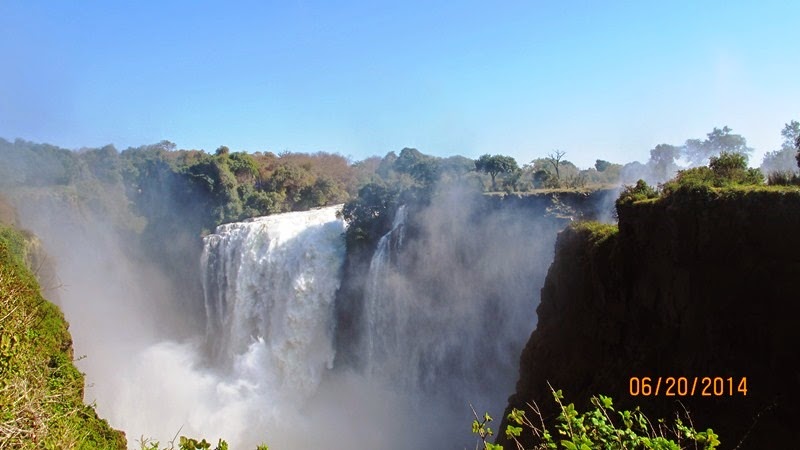
After two days watching the animals we crossed the border into Zimbabwe to visit Victoria Falls:
And we went to the Victoria Falls Hotel for lunch:
It was a fast week but we had a great trip.  Aside from having a lot of fun with my dad, it was great to have one more visit around Botswana.  There is a lot I will miss when I leave:

Wednesday, May 21, 2014

Ch-Ch-Ch-Chobe

The best thing about living in Botswana is that we have more wildlife here than anywhere else in Africa.  One of the best places to see that wildlife is in Chobe National Park.  Back in September I mentioned I visited an elephant orphanage when I was in Kenya for a conference at the same time as the terrorist attack.  The reason the baby elephants were in the orphanage was because their mothers were killed, many by poachers, before the young were old enough to care for themselves.  Africa in general has a lot of problems with poachers, but we are fortunate in Botswana that we are largely exempt from this problem.  In fact, we have the opposite problem: we have too many animals, particularly elephants.

Botswana is home to approximately half of the 400,000 elephants in Africa.  And about 100,000 of Botswana’s elephants live in Chobe National Park.  My visitors, Ashleigh and Amanda, were particularly keen to see elephants during their trip.  In an effort to satisfy their request I took them to Chobe.  We stayed at Kwalape Lodge in Kasane, which is adjacent to the park.  Since we were on a budget, and I wanted the girls to get a different experience since we stayed in a chalet previously, we opted to stay in safari tents.  They were basic, but met our needs:
While in Chobe we went on a boat cruise which is always a fun way to see the animals as they like to congregate along the shore and in the water.  I think all three of us took about a thousand pictures each, but a select few follow.  Here is a picture of Ashleigh in the boat making friends with a couple of kudu a few feet away:

And here is Amanda (before her sunglasses broke) with the elephants eating grass:
We saw hundreds of hippos:
I’m sure I am forgetting a few animals, but we saw water buffalo, kudu, impala, crocodile, monkeys, hippos, water monitor lizards, warthogs, giraffes, and of course elephants.  And since you can never have too many pictures of elephants, here is a small group, from a much larger herd, drinking on the riverbank:
We took our cruise in the late afternoon and were treated to a beautiful sunset on the ride home:
This trip reminded me how much I will miss Botswana when I leave.

Tuesday, May 20, 2014

Visitors!

I don’t know if you have ever seen the Disney movie Cars, but if you have there is one scene where two cars are lost and wander into Radiator Springs, which was previously a major tourist destination but seldom sees any visitors any longer.  As the two lost vehicles approach the town the cars which reside in Radiator Springs get excited and start to frantically prepare for their guests’ arrival.  The character that spots and announces the approaching cars starts exclaiming, “Visitors! We finally have visitors!”  That is how I feel right now.  I FINALLY have VISITORS!

Two of my friends from back in the States, Amanda and Ashleigh, arrived in Gaborone Monday evening.  I am so excited to have them here them and have spent the last week showing them around Botswana.  Tuesday morning we woke up early to head north.  Since it was a long drive and we had to spend most of the day in the car we spent the night at Elephant Sands, which is a guest house about 30 miles north of Nata.  We had intended to do a game drive that night, but the safari vehicle had broken down the previous day.  It ended up working out for the best because we were exhausted, so we moved into our chalet, ate dinner and then sat by the watering hole, desperately hoping we might see some animals stop by for a drink.  Here is a look at our chalet:

 
During our drive to Elephant Sands we saw many elephants and giraffes along the side of the road.  Aside from the evidence we saw of elephants in the area, there were also the typical warnings.  You know how there are deer warning signs?  Or moose warning signs in Alaska?  Maybe you aren’t aware of those signs in Alaska if you haven’t been there before, but they are there.  Well, here in Africa we have elephant warning signs: 

Later in the evening I was reminded of the elephant warning signs because we were standing on the porch and began hearing a lot of trees wrestling.  The next thing we knew about 20 elephants appeared about 15 feet away from our chalet.  This reminded me of the elephant warning signs and made me wonder what type of coverage I had on my rental car for animal incidents.  Fortunately there was no incident with the rental car, the elephants walked right past us to the watering hole where they drank for about 20 minutes and then left as peacefully and quietly as they arrived.  It was amazing, absolutely magical. Sorry, this isn't the best picture because it was nighttime, but you should be able to make out the shadows of the elephants:


Also along our drive to Nata we saw a dried riverbed which was just shocking.  I know there is a lot of debate about global warming and environmental changes, so take a look at this:


Those little islands with the trees on top were at least 20 feet tall and located in dried riverbeds all along the road from Gaborone to Kasane.