Showing posts with label Chobe National Park. Show all posts

Saturday, March 21, 2015

What to do (and not do) When In… Botswana

Since I returned to the United States in September, I took a new position as the Fulbright Grant Administrator at Texas Tech.  Over the past six months I’ve been busy helping professors write their grant applications, and more recently, I’ve been assisting Fulbright fellowship award winners to prepare for their sabbaticals in their host countries.

Just last week I was speaking to the woman who received a Fulbright grant to Botswana.  We spent over an hour on Skype discussing how to get a research permit, what to expect when it comes to trying to obtain a residency visa or when you go to the doctor’s office for a check-uphow not to get deported, the importance of the headlamp, dating, mating and shopping for real estate, and high-end designer duds at the Dead Muzungu Market (it’s not Louis Vuitton, but it IS an experience).

In addition to aspiring Fulbrighters recognizing my wealth of knowledge about travel in Africa, The Economist recently commissioned me to write an article for inclusion in their lifestyle and culture magazine, Intelligent Life.  Take a look at my article, which recounts what to do (and not do) when visiting Botswana.  If you understand each of these statements it means you read the corresponding blog posts, so thank you for your attention!  Enjoy:


Tuesday, June 24, 2014

One Final Safari

As my time in Africa is drawing to a close I decided it was time to take one last spin around Botswana before saying, “adieu.”  After my Kilimanjaro trip my dad came to visit which was the perfect opportunity to show him around my favorite places here.  For the past week we have been celebrating Kelly and Dad’s Week of Fun (in Africa).  We had intended to go to the Okavango Delta first, but since my flight from Kilimanjaro arrived a day late we had to cancel that part of the trip.  Instead we went to northern Botswana to visit Chobe National Park.  We took a river cruise:
We went on a game drive where we saw about a dozen lions, including two lions chasing a water buffalo across the road right in front of our vehicle:
There were about twenty game drive vehicles all in the same area of the park jockeying to get the best view of the lions; nothing quite like an African traffic jam:
We also saw some giraffes fighting:
After two days watching the animals we crossed the border into Zimbabwe to visit Victoria Falls:
And we went to the Victoria Falls Hotel for lunch:
It was a fast week but we had a great trip.  Aside from having a lot of fun with my dad, it was great to have one more visit around Botswana.  There is a lot I will miss when I leave:

Thursday, May 22, 2014

It’s Raining, It’s Pouring

The nice thing about visiting Chobe is that it is only ten miles to the Zimbabwean border which is close to Victoria Falls.  Once you cross the border you still have to drive about an hour to Vic Falls, but it is an easy day trip.  Since Amanda and Ashleigh are both on their first visit (of many I expect) to Africa, I had to take them to see the Falls.  Plus, being so close it would have been a real shame to skip it.  So we woke up early one morning, drove to the border, proceeded to Vic Falls, and then got soaked.  Actually let me back up a minute…

While at the Zim border, Ashleigh and Amanda were introduced to the true chaos of Africa.  Essentially there were a ton of people, each one jostling for a place in line, shoving one another and trying to get the attention of the border patrol officers in order to get through as quickly as possible.  I actually felt a little bad because I am accustomed to this kind of behavior, but my friends aren’t.  After I was processed I turned around to see them politely waiting their turn, so I grabbed Ashleigh and practically threw her through the visa window in an effort to make sure the immigration officer helped her before someone line jumped her.  Fortunately we made it out in one piece with the girls laughing to one another saying, “So and so could never come to Africa, she couldn’t handle that kind of stress.”  That is right; Africa isn’t for the faint of heart.

We made it to Victoria Falls around 9am.  As we were headed toward the Falls we saw some baboons in a car.  You may have read a while back that there was some concern over the monkeys on campus learning how to drive.  Well, it appears the baboons may have beaten them to it.  In all reality, the baboons were not driving the car; they were making out (and doing a little bit more) in the backseat.  I’m glad that wasn’t my car:
Dr. David Livingstone, my namesake, is believed to have been the first European to have seen the falls back in 1855.  If you want more information about Victoria Falls you can check out my previous blog post about it here.  I had never been to the Zambian side of the Falls before, so that was the side we decided to explore.  As we drove into the town of Victoria Falls we could see the spray from the Falls.  Then as we were crossing the bridge from Zimbabwe to Zambia we began to feel the spray.  Any time you cross the bridge lots of people approach you asking you if you want to bungee jump.  We did not partake, but here is a picture of the bridge, with a rainbow due to the spray, and a bungee jumper (he is in an orange shirt directly above the rainbow):
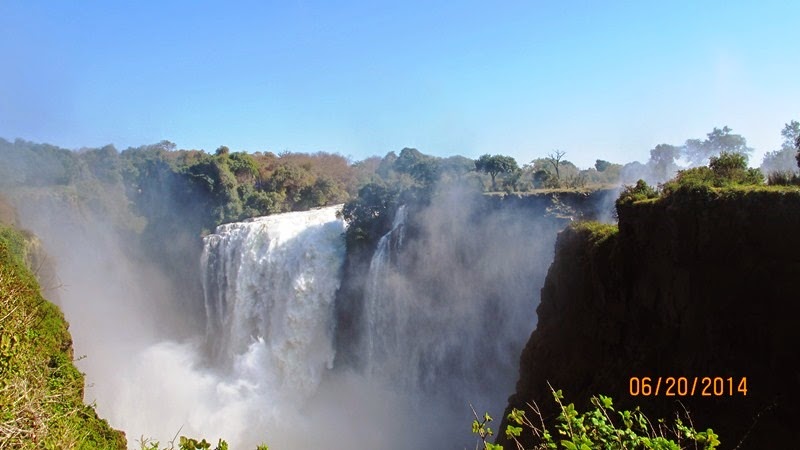
It wasn’t until we got a little closer that we REALLY felt the force of the Falls.  In fact most of our pictures didn’t turn out properly because the mist was so extreme it looked as if we were standing in the middle of a fog storm.  But here is one shot of the Falls that did turn out well:
We also made lots of friends because everyone wanted to get their pictures taken with us:
We spent about two hours visiting the park and ultimately ended up looking like drowned rats, but we loved every last WET minute of it:

Wednesday, December 4, 2013

Here, have a condom

Living in Africa I have learned a lot about sex.  Not necessarily from the act itself, but because it is a constant topic of conversation.  Here people make reference to sex the same way you talk about weather or sports scores back in the U.S.

For one, fidelity is rare.  I know Westerners can’t claim to always be faithful, but the prevalence and acceptance of adultery here is just so customary it is unnerving at times.  If you haven’t read about my education surrounding big and little houses here in Botswana I recommend you start there so you have the vocabulary down.  But men and women talk about little houses openly and as a necessity; men need a little house as a means of escaping the demands of a marriage; women want to be a little house because of the monetary and social benefits it bestows upon them.
Part of the problem with infidelity here is the HIV/AIDs issue.  I had a friend tell me both her parents died from HIV/AIDs.  She said her father contracted it from sleeping around.  Apparently he knew he was sick, but never told her mother.  When her father died her mother was told by the doctor about him having had HIV/AIDs and encouraged her to be tested.  By that point her mom had already contracted it and died about a year later as a result.

The infidelity, coupled with the frequency of HIV/AIDs, has resulted in what I like to call a “Condom Culture.”  I have never seen so many condoms in so many places in my life.  And when in doubt, the answer is always, “here, have a condom.”  I mentioned during a shopping trip a couple months back that I was looking for a sink stopper.  When the store clerk couldn’t figure out what I wanted he gave me a box of condoms.  I didn’t realize it at the time, but that is the answer to everything here.  The other day I was in a store and mistakenly asked for pants instead of trousers.  What did the store manager give me? That’s right, condoms.
And the “here, have a condom” slogan isn’t evident just in my apparent inability to communicate when shopping.  In the women’s restroom in my building on campus there is a box of condoms with a sign, “Help yourself.  Practice Safe Sex.”

When I first arrived in Gaborone I stayed at a hotel for a couple of nights before I was given the keys to my house.  It was a nice hotel; the front desk clerk even took me up to my room to show me the amenities.  I’m not sure whether it was part of her rehearsed script or not, but she opened the drawer to the nightstand, pointed to a handful of condoms and said, “If you need more, don’t be afraid to ask.”
But I think my favorite “Condom Culture” experience was when I drove across the Botswana-Zimbabwe border.  A group of journalist friends and I were on a visit to Chobe National Park.  As we were shuffling through the small border check point on the Botswana side I turned around after getting my entry stamp only to notice a condom dispenser.  I was so shocked I looked at it for a minute.  There was a sign on the dispenser which read, “Have a good time. Be safe.  Help yourself.”

Tuesday, September 3, 2013

My First Press Tour to Chobe National Park

I am not a member of the press, and I have no real intention of becoming one.  But I was recently invited on a press tour by the Director of the Botswana Tourism Organization (BTO).  BTO is basically the main marketing body for all of tourism here in Botswana.  BTO does not make policy; the Ministry of Environment, Wildlife and Tourism (MEWT) does that.  But BTO takes the policies which MEWT makes and finds ways to implement them and increase tourism throughout the country.

Since the UNWTO conference was held right next door by our neighbors to the north (Zimbabwe and Zambia) BTO decided to take advantage of the fact there were so many media correspondents in the region and arranged several press tours in hopes of some free PR.  Fortunately for me, the Director of the BTO invited me to tag along so I could see some of the sights.  I was so happy to participate because I teach about some of these areas in my class, I haven’t done any real tourism since I arrived in Botswana, and it was a free trip!  So, I really appreciated the opportunity.

I haven’t spent much time around journalists, so the trip was as much about seeing the animals in their natural habitats as it was about observing how the media operates.  In a way I felt a little bit of peer pressure.  Granted, they all knew I wasn’t “one of them” and they were very welcoming, but as I watched them work I felt like I was being a bit of a slacker and needed to keep up.  To put this statement in perspective, I would watch them taking hundreds of photos in a matter of seconds of one bird.  I would take one picture of the same bird and then call it quits.  But then I would watch them continue to snap more photos, this time with different cameras!  I would think about it for a second and consider that maybe I missed something.  Then I would take another picture of the bird.  This behavior: action-observation-reaction-repeat; continued to gain momentum until I was taking hundreds of pictures within seconds of the same animal.  By noon I had taken 942 photos.  And then what do you think happened? My camera battery died.

It turned out the expiration of my battery was a blessing in disguise.  In the morning we took a boat trip along the Chobe River and were able to see (and photograph) all kinds of animals.  But, by the time the game drive began three hours later I was forced to watch and enjoy since my camera was out of juice.  Below are some of the highlights from the trip.

Journalists taking a million pictures of an animal:

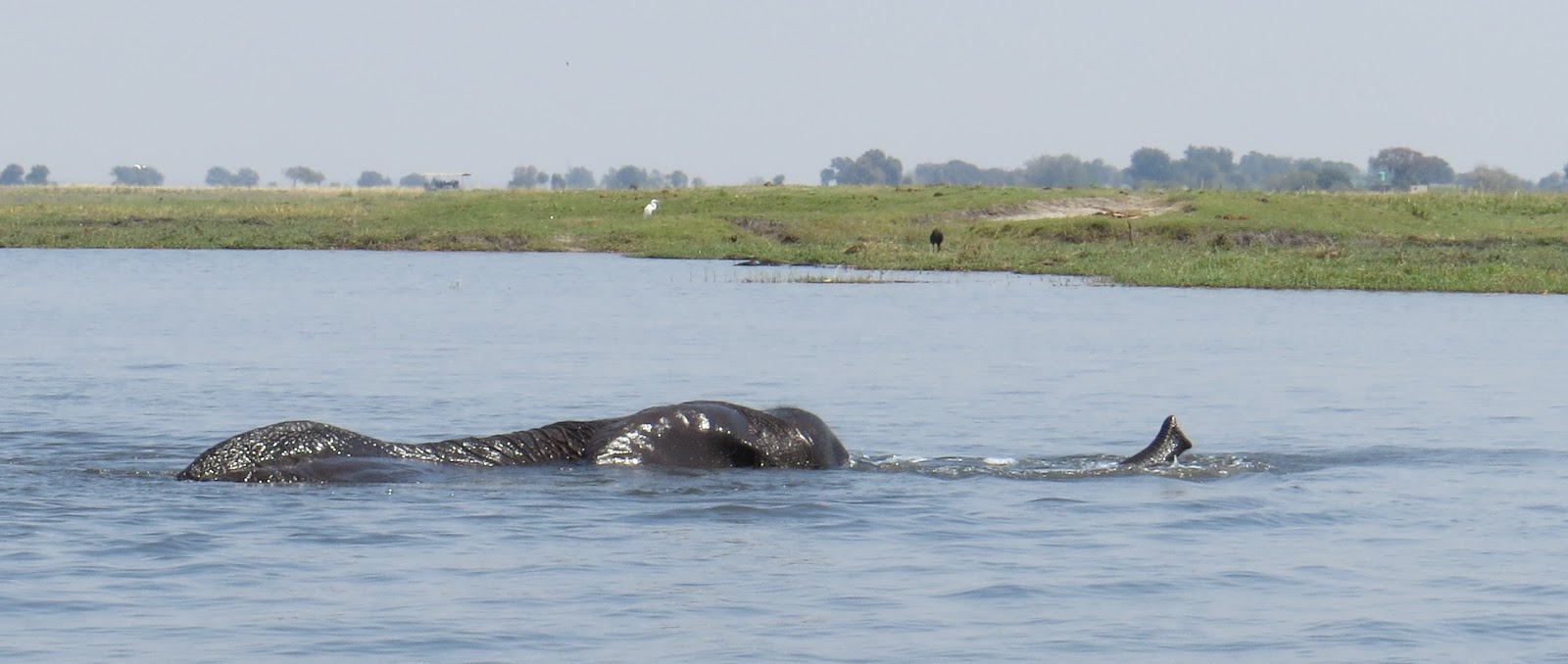
An elephant swimming from the main land to an island in the middle of the river:

Crocodile in the forefront, impala in the middle, water buffalo waaaaaay in the distance:

Hungry, hungry hippos having some lunch:

Overall it was an excellent trip.  I have no doubt I will visit the area again, especially when I have visitors. I did get tons of pictures and after looking at them I understand why the journalists take so many photos.  Often it wasn’t the first shot which was the best one, but the seventh or eighth which I preferred.  Thank goodness for digital.