Showing posts with label Zimbabwe. Show all posts

Sunday, August 2, 2015

Cecil the Lion

Similar to a DJ, I love to take requests for blog topics.  And this week I had several messages from loyal blog followers asking that I address “Cecil the Lion.”  Well, first I had to figure out who Cecil the Lion was.

Cecil the Lion did not make the news here in Australia.  However, it was the second most popular Google search topic in the U.S. last week.  I read the newspaper articles, watched the YouTube clips of all the late night hosts, and I have some information you need to know if you are going to speak intelligently about this situation.

The first thing you need to be familiar with is CITES (Convention on International Trade in Endangered Species of Wild Fauna and Flora).  If you want to know whether a fish, bird, animal or plant is in danger and needs protection, you can find out on the CITES website.  CITES categorizes living fauna or flora into one of three “appendices.”

Appendix 1 is for animals needing the most protection because they are in danger of becoming extinct.  There are about 1,200 species in appendix 1, including the mountain gorilla, the Asian elephant, and all rhinos.  In short, it is illegal to trade in Appendix 1 animals without a licensed permit.  According to CITES regulations, Mozambique is permitted to export 60 lions (as wild-taken trophies) annually so long as the required permits are obtained.

Most species (about 21,000) are listed in Appendix 2.  They aren’t necessarily likely to become extinct, but may become so in the future if trade in these animals becomes more popular.  Import permits are not required from CITES for Appendix 2 species, but individual countries may prohibit these items from being permitted.  For instance, Australia prohibits importation of almost any animal product regardless of CITES or anything else because we like to control our borders like Fort Knox.  The great white shark and the American black bear are Appendix 2 species.

There are only about 170 species on Appendix 3.  An animal can be listed on Appendix 3 at the request of any CITES member country because that one country is having trouble controlling the species.  Costa Rica has placed the two-toed sloth on the CITES Appendix 3 list.

Now that you have some background, let’s talk about elephants.
In Botswana, elephants are a CITES Appendix 2 animal.  That means they are NOT in danger of extinction.  This means that Botswana has every right to allow hunting of elephants.  However, because Botswana likes to play Big Brother to Africa, and rightfully so, they’ve earned that honour, Botswana decided to banish elephant hunting 18 months ago.  And Botswana is REALLY regretting that decision right now.  Botswana figured if it got rid of hunting other countries would follow suit.  Other countries have not necessarily followed Botswana’s lead, and there have been some negative repercussions for Botswana because the elephant population is now exceeding carrying capacity.

Botswana has half the elephant population in Africa, and one-third of the entire elephant population in the world.  Previously, when elephant hunting in Botswana was allowed it was strictly limited.  I think they only sold about 100 permits a year.  At $100,000 a piece.  That’s $10 million dollars in permits only.  Then they also had to hire guides, hunters, pay for accommodation, transportation, and plenty of other services while in country.  At a conservative estimate let’s call that $25-30 million in economic impact from hunters ONLY.

Now, here’s the deal.  You can’t just kill one elephant.  Elephants understand when one of their herd dies from natural causes or from an attack by a predator.  They do NOT understand when a family member is killed by a human.  Herds are typically about 30-50 elephants.  When one is killed by a human the rest of the herd goes rogue and can’t deal with the depression.  So, one hunter kills one elephant (for the permit he purchased) and then the village that is responsible for that permit kills the rest of the herd.  This is called culling a herd.  This may sound cruel, but it isn’t.  The elephant which the hunter killed, and the rest of the herd, is used to feed the village for the year.  So, while this is generating a lot of money for the government and the village, it is also a form of subsistence living.

Back to today.  We have over 200,000 elephants in Botswana.  When we used to hunt, we used to eliminate about 5,000 elephants each year, which helped to control the elephant population.  The population continued to grow, but not at the fast rate which it grows today because there is no external method of controlling it.

Adult elephants eat about 300-400 pounds of food a DAY!  And they are herbivores.  That means they eat grass.  What else in Africa eats grass?  Giraffes, zebras, rhinos, impala, and the vast majority of African wildlife.  Elephants also live to be about 70 and they eventually starve to death because their teeth wear out and they can’t actually get enough nutrients to survive.  So, in truth, I think killing a 60 year old elephant is actually very humane.  But, back to the food issue.  As a result of the growing elephant population in Botswana other species have actually decreased in number because they are competing for the same food.

OK, now let’s talk about Cecil.  In truth, I find it rather difficult to talk about the Cecil situation because there has been so much media coverage, and media is there to sell a story.  I’ve read and hear a lot of conflicting reports, so I think it’s a bit difficult to know the truth from the fanaticism about this story.

What I will say is that there is a HUGE difference between poaching and hunting.  I actually just wrote a research article on this topic.  Perhaps I should write a blog post summarising that academic article.  The poaching you hear about is normally of elephants in Kenya and Tanzania.  The poaching that occurs there is truly unfortunate and in most cases the money earned from these illegal activities is used to support extremist, terrorist groups.

Hunting in Africa is closely regulated.  There are permits that must be obtained, particular rules that must be followed, and the legal repercussions are worse than any social ostracism you could possibly experience in the U.S.  The locations which permit hunting are highly dependent on that income and there are strict requirements regarding how the meat must be utilized.

In short, if the hunt was TRULY illegal then I’m against it.  However, Zimbabwe is no saint.  Mugabe’s government has been corrupt from the beginning, he has been guilty of human rights violations for years, and he’s starving his people.  The hunters involved in the Cecil situation were thrown in jail, and Zimbabwe’s call to extradite the dentist is likely an attempt to sensationalize this and drag the U.S. into negotiations for something.  If the U.S. elects to extradite the American dentist to Zimbabwe it will be his death sentence.

If you are unfamiliar with Mugabe, this Nando’s (a popular South African fast food chain) commercial depicts him with Kim Jun Un, Idi Amin, Gaddafi, Saddam Hussain, and all the other 20th century dictators.  The commercial is pretty accurate as Mugabe IS the last one standing:


Saturday, June 28, 2014

The Poverty-Weather-Suicide Correlation

I’m enjoying the conference I’m currently attending because there are people here from all over.  Aside from me there are only two Americans, but there is a large contingent from Europe and Africa.  Since I am a bit unusual as I haven’t left Africa for the past year a number of people have approached me and asked a variety of questions about my time here on the continent.  Today I had a conversation with someone about poverty in Africa.  I told her that most government officials in Africa regard poverty as being out of their control, something they simply can’t change.  Just like they can’t predict or influence the weather, they can’t influence or change the occurrence of poverty.

Botswana is considered an upper middle income economy, but according to the World Bank 32.9% of the population still lives below the national poverty level.  Of course, Botswana is the wealthiest country in sub-Saharan Africa.  I know I’ve mentioned some of the unemployment issues in countries like Nigeria (54.7% of the population lives in poverty) and Zimbabwe (72% poverty), that Lesotho (56.6% poverty) used to be so poor that one of their primary exports was human blood, and that Congo (71.3% poverty) is so unfortunate they can’t afford to eat the cassava and instead they eat the leaves from the plant.  Poverty alleviation is a huge key term which you hear all over the place.  But the truth is most African leaders don’t think poverty can be cured, so they don’t really sweat it.

It should be noted that poverty alleviation is different from economic growth.  I have a friend who works for the World Bank.  His job is to identify aspiring entrepreneurs, give them micro loans- typically $1,000 or less- in an effort to get them to improve their socioeconomic status.  He can’t GIVE this money away!  He told me about a conversation he had with a fisherman.  The fisherman said he caught three fish each day and then sold them; that would meet his needs.  Mr. World Bank explained he would loan him money to buy a new boat, or new nets, or whatever he needed to improve his business so he could catch more fish.  The fisherman’s response: “I don’t need to catch more fish.” Mr. WB explained if the fisherman caught more fish he could send his son to university, or have the money if his wife got sick, or maybe just buy some milk for his family.  The fisherman said he didn’t need money in case those things happened.  He said when his wife got sick he would just catch five or six fish that day to buy her medicine or pay the doctor.

The reason the fisherman in the story didn’t want to earn extra money is because he would never get to save that money, so it was pointless.  The challenge with elevating Africa out of poverty and improving standards of living is because the culture here does not encourage future planning.  Family ties are important and everything is communal.  This means if the fisherman catches 10 fish and suddenly has more money his aunt in the village will show up and ask for the money to pay her medical bills.  If he catches 20 fish he won’t see any profit from that either because his distant cousin in the next village will ask for the money to pay the bride price for her son’s upcoming marriage.  If he catches 50 fish then the niece of his neighbor’s granddaughter in the country next door will show up on his doorstep asking for a loan to pay for her father’s funeral announcement.  And the cycle continues and never ends.

As I continued my conversation with the woman at the conference today she asked me how Africans are able to withstand so much poverty, violence, government instability, persecution, disease and everything else they put up with.  Just last night I finished the book David and Goliath by Malcolm Gladwell.  In his book, Gladwell states that happiness is measured on a sliding scale in relation to one’s peers.  He states that Switzerland has the happiest people in the world.  However, Switzerland also has one of the highest suicide rates.  By contrast, Africans are significantly less happy because of all the challenges associated with living here, but since everyone else here is miserable (at least in terms of material possessions, wealth, etc.) the suicide rate is very low because they can’t look at others and be envious since everyone is in the same (sad) boat.

Friday, June 27, 2014

Presidential Protocol

If you’ve been following my blog for a while and read my posting back in December about How to Make a Speech (in Africa) then you probably already know where I’m going with this title.  If you missed that blog you can read it here.

As I mentioned yesterday I am here in Mauritius for the Advances in Hospitality and Tourism Marketing and Management Conference.  The fun thing about going to conferences in Africa is that the organizers take them very seriously, so they often bring high ranking public officials to be keynote speakers or guests of honor in order to show attendees how much the country values the topic of the event.  For instance, at the opening session of the conference today the President of Mauritius was the keynote speaker.  In the past year I have seen President Khama of Botswana, President Mugabe of Zimbabwe, President Sata of Zambia and now President Purryag of Mauritius at conferences.  In the last 35 years I have NOT seen Presidents Carter, Reagan, Clinton or Obama.  I did have breakfast with former President Bush Sr. when he was a speaker at an event I did in Vegas and while I didn’t meet W. (George W. Bush) I did ride in his limo when he did an event of mine while I was working at Disney- though that was before he became prez.  To put this in perspective, I have a 100% presidential citing average at conferences in Africa.  Considering the fact I have probably organized at least 500 events over the years that means I have seen presidents at 0.004% of my events in the U.S.

Of course, having a president, or any well-known public servant attend an event here calls for protocol.  First there is a red carpet.  I didn’t take a picture of today’s red carpet because it wasn’t one of the nicer red carpets I’ve seen in the last 12 months.  But, you can see Mugabe’s red carpet here if you like.  Of course, before the official of note shows up there is the corralling of all the staff at the hotel, as well as the entourage.  Mugabe travels with a presidential escort of 60 vehicles and hundreds of personal guards and staff.  I didn’t witness the line of all the hotel employees standing outside the hotel for inspection upon arrival by President Purryag today, but I know it happened based on reports by other conference attendees.

Once the official arrives there is the playing of the national anthem, then the seating ceremony.  Now, up until this point I follow along like a well behaved guest.  I only reveal my true colors once the speeches begin.  And today was no exception to the rule.  Each time someone spent five minutes saying hello to all the honored delegates and then stated, “Protocol observed” it was all I could do not to burst into laughter. Again, if you don’t know what I’m talking about with the “protocol observed” you REALLY need to read this blog post.

All in all the visit from President Purryag was positive.  He had a lot of good comments regarding tourism in Mauritius and Africa as a whole.  Plus, it was fun to have one final reminder about protocol and speeches before I head home.  Thanks for the memory President Purryag!

Tuesday, June 24, 2014

One Final Safari

As my time in Africa is drawing to a close I decided it was time to take one last spin around Botswana before saying, “adieu.”  After my Kilimanjaro trip my dad came to visit which was the perfect opportunity to show him around my favorite places here.  For the past week we have been celebrating Kelly and Dad’s Week of Fun (in Africa).  We had intended to go to the Okavango Delta first, but since my flight from Kilimanjaro arrived a day late we had to cancel that part of the trip.  Instead we went to northern Botswana to visit Chobe National Park.  We took a river cruise:
We went on a game drive where we saw about a dozen lions, including two lions chasing a water buffalo across the road right in front of our vehicle:
There were about twenty game drive vehicles all in the same area of the park jockeying to get the best view of the lions; nothing quite like an African traffic jam:
We also saw some giraffes fighting:
After two days watching the animals we crossed the border into Zimbabwe to visit Victoria Falls:
And we went to the Victoria Falls Hotel for lunch:
It was a fast week but we had a great trip.  Aside from having a lot of fun with my dad, it was great to have one more visit around Botswana.  There is a lot I will miss when I leave:

Tuesday, June 3, 2014

Money, Money, Money, Money...MOOOOOO-NEY!

Though I’m not scheduled to leave Africa for a few more weeks, I thought it a good idea to start going through all my belongings and trying to downsize as much as possible.  Believe it or not, I spent a good 20 minutes trying to streamline my wallet this morning.  As a rule, when I travel, I eliminate all unnecessary items from my wallet.  When friends come to visit and I see them carrying a wallet full of 10 different credit cards, their library card, their Red Cross blood donor card, their Social Security card, and countless other cards they will never use, but are highly likely to lose here, I cringe.  When I moved to Africa I brought the following: 1 personal credit card, 1 credit card for university-related/business purposes, 1 bank debit card, my travel insurance card, and my emergency evacuation/I’M IN A LOT OF TROUBLE GET ME THE HELL OUT OF HERE! supplementary insurance card.  That’s it!  I have since added a Botswana driver’s license.

Despite having the two credit cards and the debit card, I only use these about half the time.  Southern Africa has begun using plastic on a more regular basis, but Zimbabwe and most of central and east Africa still operate on a strictly cash system.  I knew cash would be necessary, so when I came here I brought $5,000 with me and have since changed or used most of it.  Similar to the patriotism displayed in my blog post about how I was proud to be an American and would NEVER give up my passport to obtain citizenship elsewhere, there is a lot to be said about the power of the U.S. dollar.  You know the commercial, “Visa: Accepted Everywhere”?  Not true.  It should really be, “U.S. Dollars: Accepted Everywhere.”  Though I should add that when travelling to Africa if you plan to bring a credit card, choose Visa.  My university card is a Master Card and I haven’t been able to use it several times because Master Card isn’t as widely accepted as Visa.  Apparently those Olympics commercials with Morgan Freeman ARE telling the truth.

As I was organizing my wallet today there was no need to go through my cards as those have remained stagnant.  But my supply of banknotes and coins has changed considerably.  My stash of U.S. dollars is barely enough to get me through the next couple months, but I can now rest assured that if I get stranded in any one of a dozen African countries I can buy a bottle of water, and in some cases, even dinner if necessary.  Here are some of the bills I’ve collected during my tenure in Africa:

(Left to right, top to bottom): Ugandan Shilling, Rwandan Franc, Congolese Franc, Ethiopian Birr, Zimbabwean Dollar (This is no longer in circulation. Zimbabwe has no official currency, so the U.S. dollar is primarily used, but you can now use 8 different foreign currencies as legal tender), Zambian Kwacha, U.S. Dollar, Kenyan Shilling, Namibian Dollar, Botswana Pula, Sierra Leonean Leone, South African Rand, and Lesotho Loti.

None of these bills are worth more than a dollar or two, except for the Rand and Pula which are about $20 and $23, respectively.  But I will definitely spend those as SA and Botswana are where I will be most of the time until I leave. 

Thursday, May 22, 2014

It’s Raining, It’s Pouring

The nice thing about visiting Chobe is that it is only ten miles to the Zimbabwean border which is close to Victoria Falls.  Once you cross the border you still have to drive about an hour to Vic Falls, but it is an easy day trip.  Since Amanda and Ashleigh are both on their first visit (of many I expect) to Africa, I had to take them to see the Falls.  Plus, being so close it would have been a real shame to skip it.  So we woke up early one morning, drove to the border, proceeded to Vic Falls, and then got soaked.  Actually let me back up a minute…

While at the Zim border, Ashleigh and Amanda were introduced to the true chaos of Africa.  Essentially there were a ton of people, each one jostling for a place in line, shoving one another and trying to get the attention of the border patrol officers in order to get through as quickly as possible.  I actually felt a little bad because I am accustomed to this kind of behavior, but my friends aren’t.  After I was processed I turned around to see them politely waiting their turn, so I grabbed Ashleigh and practically threw her through the visa window in an effort to make sure the immigration officer helped her before someone line jumped her.  Fortunately we made it out in one piece with the girls laughing to one another saying, “So and so could never come to Africa, she couldn’t handle that kind of stress.”  That is right; Africa isn’t for the faint of heart.

We made it to Victoria Falls around 9am.  As we were headed toward the Falls we saw some baboons in a car.  You may have read a while back that there was some concern over the monkeys on campus learning how to drive.  Well, it appears the baboons may have beaten them to it.  In all reality, the baboons were not driving the car; they were making out (and doing a little bit more) in the backseat.  I’m glad that wasn’t my car:
Dr. David Livingstone, my namesake, is believed to have been the first European to have seen the falls back in 1855.  If you want more information about Victoria Falls you can check out my previous blog post about it here.  I had never been to the Zambian side of the Falls before, so that was the side we decided to explore.  As we drove into the town of Victoria Falls we could see the spray from the Falls.  Then as we were crossing the bridge from Zimbabwe to Zambia we began to feel the spray.  Any time you cross the bridge lots of people approach you asking you if you want to bungee jump.  We did not partake, but here is a picture of the bridge, with a rainbow due to the spray, and a bungee jumper (he is in an orange shirt directly above the rainbow):
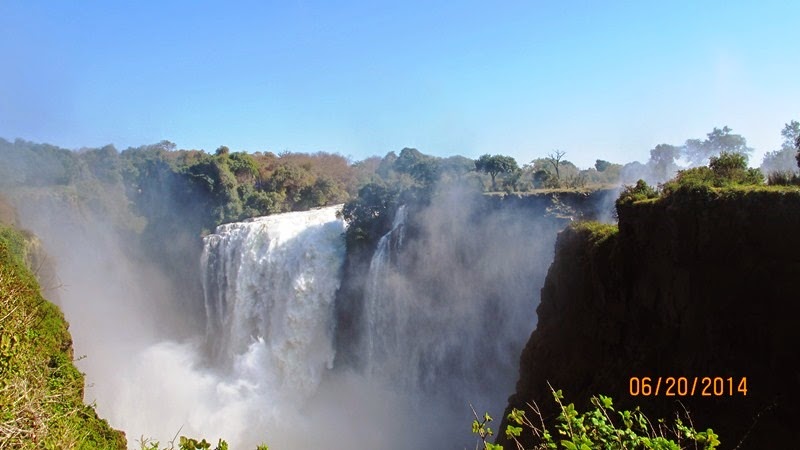
It wasn’t until we got a little closer that we REALLY felt the force of the Falls.  In fact most of our pictures didn’t turn out properly because the mist was so extreme it looked as if we were standing in the middle of a fog storm.  But here is one shot of the Falls that did turn out well:
We also made lots of friends because everyone wanted to get their pictures taken with us:
We spent about two hours visiting the park and ultimately ended up looking like drowned rats, but we loved every last WET minute of it:

Wednesday, May 21, 2014

Ch-Ch-Ch-Chobe

The best thing about living in Botswana is that we have more wildlife here than anywhere else in Africa.  One of the best places to see that wildlife is in Chobe National Park.  Back in September I mentioned I visited an elephant orphanage when I was in Kenya for a conference at the same time as the terrorist attack.  The reason the baby elephants were in the orphanage was because their mothers were killed, many by poachers, before the young were old enough to care for themselves.  Africa in general has a lot of problems with poachers, but we are fortunate in Botswana that we are largely exempt from this problem.  In fact, we have the opposite problem: we have too many animals, particularly elephants.

Botswana is home to approximately half of the 400,000 elephants in Africa.  And about 100,000 of Botswana’s elephants live in Chobe National Park.  My visitors, Ashleigh and Amanda, were particularly keen to see elephants during their trip.  In an effort to satisfy their request I took them to Chobe.  We stayed at Kwalape Lodge in Kasane, which is adjacent to the park.  Since we were on a budget, and I wanted the girls to get a different experience since we stayed in a chalet previously, we opted to stay in safari tents.  They were basic, but met our needs:
While in Chobe we went on a boat cruise which is always a fun way to see the animals as they like to congregate along the shore and in the water.  I think all three of us took about a thousand pictures each, but a select few follow.  Here is a picture of Ashleigh in the boat making friends with a couple of kudu a few feet away:

And here is Amanda (before her sunglasses broke) with the elephants eating grass:
We saw hundreds of hippos:
I’m sure I am forgetting a few animals, but we saw water buffalo, kudu, impala, crocodile, monkeys, hippos, water monitor lizards, warthogs, giraffes, and of course elephants.  And since you can never have too many pictures of elephants, here is a small group, from a much larger herd, drinking on the riverbank:
We took our cruise in the late afternoon and were treated to a beautiful sunset on the ride home:
This trip reminded me how much I will miss Botswana when I leave.

Friday, February 14, 2014

President Phelan, I Presume?

For the last two days I blogged about the time I spent working for the U.S. Embassy back in December on a youth exchange.  During that week I learned something very important: I will NEVER be a politician.  Feel free to quote this statement back to me if in 50 years I have a change of heart.  But I don’t think I will.

During the exchange we had three diplomats in tow: the U.S. Ambassador to Botswana, the U.S. Ambassador to Zimbabwe and the Deputy Assistant Secretary (DAS) of State to Africa.  My undergrad degree is in International Relations.  At one point I seriously considered going to work for the foreign service or another government agency, but fortunately I decided to forego those options.  Looking back on it, I couldn’t be happier with my choice.
Early on in the trip I realized I didn’t particularly fancy the DAS or the Bots Ambassador (BA).  I couldn’t quite put my finger on it.  I definitely liked the Zim Ambassador (ZA) because he could hold a conversation.  But trying to talk to DAS and BA was like pulling teeth.  It was a lot of one word answers and unwillingness to give any details or go further in the conversation than absolutely necessary.  ZA was significantly better at holding a conversation, and the kids really liked him for that fact.  It took me a few days to realize it, but DAS and BA were political appointees, i.e. politicians.  ZA was a career foreign service officer, so he had started at the bottom stamping visa applications and worked his way up through the ranks to become an Ambassador.  This stark contrast definitely solidified the view that politicians only talk to you when they want something and then don’t want to be bothered once they have met their objective. 

One of the things I disliked about these three officials being at the exchange was that they treated everything as if it was a photo op.  They never talked to the kids.  They were always reading speeches, which drove me nuts.  The press wasn’t there.  So what was the point of reading all these prepared statements?  The kids had no idea what they were saying because they failed to use high school English.  The perfect example was when BA decided to lead a session on gender-based violence.  At no point in time did she explain the concept of gender-based violence.  After her ten minute monologue about how it was bad we were broken up into groups with the kids to lead them in discussion about gender-based violence using questions we had been given.  I quickly realized my group of six was lost.  I asked them if they knew what gender-based violence was.  They all shook their heads no.
Sadly, by the last day, even my admiration for ZA, the only semi-human of the three, had dissipated.  During a session he made a statement about how GMOs (genetically modified organisms) were the future of Africa.  No matter how hard he might try to convince me, he and I can NEVER be friends now.

Despite my disappointment with the three diplomats, there was one thing I loved.  During a “formal” dinner- is there such a thing in Africa?- they were heavily involved in making their speeches.  The venue had windows without glass; it was nighttime and the bugs were entering the building en mass.  This would have been the perfect time to have gone off script and perhaps not used the speeches, but they were all determined to get their time in front of the 30 high schoolers who were paying absolutely no attention and were busy catching the bugs and lighting them on fire using the candles on their tables.  (Insert laughter here.)  Sadly, the only picture I have of the bug fiasco is horribly out of focus, but I think this lets you imagine the scene for yourself:

Thursday, February 13, 2014

The Youth Exchange (Part Deux)

As I mentioned yesterday, back in December I worked with the U.S. Embassy on a youth exchange program.  If you haven’t heard about it you can read here about the portion which took place in Botswana.  After the two days in Botswana were completed we all crossed the border into Zimbabwe.  There is nothing more chaotic than trying to take 30 high school students, 12 high school teacher chaperones, about a dozen U.S. Embassy staffers (half from the Botswana embassy, half from the Zimbabwe embassy), two Ambassadors and a Deputy Secretary of State through a border crossing (two actually).  I think it took about three hours to get processed out of Botswana and into Zimbabwe.

Once we got to Zimbabwe we went to the National University of Science and Technology in Bulawayo where another Fulbright Professor gave a talk on water conservation.  I actually learned a lot.  For instance, did you know that the average human utilizes between 1,000 and 6,000 liters of water per day?  That’s right, here’s his powerpoint slide which states it:
We also visited the Natural History Museum which had a TON of specimens on display, the Khami Ruins, and Matobo National Park and Rhino Reserve where I learned that if you are suspected of being a poacher you will be “shot on sight, no questions asked.”

During our game drive in Matobo as I was sitting in the back of the vehicle I peered through the back windshield and saw this:
YES! A messy dashboard.  No! Not that!  Look closer.  It is a Texas Tech University baseball cap.  Apparently a group of students from Tech were at the National Park over Thanksgiving break.  I forget which department they were from, either an animal or science based department obviously, but they had been there for a week to study the rhinos.

Wednesday, February 12, 2014

Chaperoning a Youth Exchange

Back during the first week of December the U.S. Embassy hosted a youth exchange program.  Fifteen high school students from Botswana and fifteen from Zimbabwe were involved, along with six teachers from each country.  The first two days were spent in Francistown in Botswana and then the following two days the entire group was in Bulawayo, Zimbabwe.  Last night I went to an event at the U.S. Embassy and as I was speaking to someone about the exchange I realized I completely forgot to blog about it.  I did put up a video from Siyaya, one of the groups that performed, but I never talked about the exchange itself.

The theme for the exchange was “Conservation, Health and Economic Opportunities.”  I was asked by Amanda, my Public Affairs Officer at the Embassy, if I would come along and do a session on tourism since wildlife protection, water and sustainability were all part of the agenda.  I agreed and since I was invited to come along for the entire week to help out I figured, why not?

Overall the exchange was exhausting but a lot of fun.  When the group was on the Botswana side of the border we stayed on a nature reserve where we went on a game drive:
Had a presentation by CDC about nutrition and sexual health, did a career panel with a number of community leaders, and did community service projects.  My group was responsible to cleaning up a community center, which included collecting, installing garbage bins and planting trees:
As with any event, there were a number of funny (and at times, frustrating) hiccups along the way.  For instance, the contact at the nature reserve agreed to arrange a bus to pick up the Botswana kids to drive them an hour to the reserve.  I was standing at the school with fifteen kids, six teachers and at least two dozen pieces of luggage when a combi pulled up playing deafening reggae music.  A combi, for those of you less familiar is a family sized van which holds about 10-12 people VERY uncomfortably.  You cannot fit any luggage or really anything larger than a purse which can sit on your lap in a combi because everyone is squeezed in so tightly.  I calmly called Amanda (the Embassy PAO in charge of the Botswana portion of the exchange) and asked for permission to take matters into my own hands.  Once said permission was obtained the person at the nature reserve realized he made a grave mistake and I would be all over him to get this right until the minute we departed for Zim.  I guess it is the event planner in me.

I also took one for the team when, just as we were getting prepared to start our very first session, I discovered, quite painfully, that there was a huge wasp nest directly over the door.  So you basically couldn’t get in or out without being attacked.  Apparently wasps are my kryptonite, because those stings all over my back, neck and shoulders lasted about three weeks.

But, one of the best/worst funny moments happened on the first night at the reserve.  The kids and teachers were actually camping on the reserve.  The rest of the Embassy staffers (myself included) were staying an hour away at a hotel in town.  We were so exhausted that first day and desperate to get back to our hotels in order to get some sleep.  After driving 45 minutes from the campsite to the gate of the reserve we had to stop in order to open up the gates.  I jumped out of the SUV, ran up to the gate to find it chained and locked.  Keep in mind it was about 11:30pm and there was no cell phone reception in the reserve.  I turned around to the two vehicles anxiously watching me and shook my head.  They thought I was kidding.  After searching around the shed next to the gate we found a key and managed to let ourselves out.  No such thing as a dull moment in the wilderness.

Thursday, January 30, 2014

Not Cereal Mom, SERIAL Mom

In the early 1990s the movie Serial Mom was released in theaters.  The movie depicted Kathleen Turner as a suburban housewife and mother who protected her family without fail, going so far as to murder anyone who wronged her children.  I don’t believe my mother has ever broken the law for her kids- though I wouldn’t totally put it past her- but she is about as close to Kathleen Turner’s character as one can get.  Of course, I also think that is an innate maternal trait.

Another thing I find particularly funny about moms is their competitive streak.  And I don’t mean about themselves, I mean that in regard to their kids.  I remember when I told my mom I was moving to Africa.  She was happy about it because I was happy, but in reality her response was kind of a mopey, “I know, I’ll just really miss you.”  My brother and I sort of laughed about it and said, “Are you kidding me? This gives you bragging rights amongst all the other moms for the next year.  When all you moms get together and compare who has the cooler kids you will always win, hands down.  And you know you moms do it, don’t even try and deny it.”
This is how I imagine water cooler talk at my mother’s office:

Mom #1: My daughter just bought her first house, at the age of only 23.
Mom #2: I will see your new home-owning daughter and raise you my son, a Navy Seal who swam across the Mediterranean without equipment and then single-handedly rescued five civilians from almost certain death.
KVP’s Mom: I recommend you all fold now.  My daughter is currently in Africa where she is overseeing the Botswana Defense Force and the police.  On the weekends she is training monkeys how to build power plants in order to supply electricity and water to locals.  In her free time she is either in Zimbabwe teaching President Mugabe how to balance the budget and mint a new stabilized currency or instructing Ethiopian Airlines and South African Airlines how to provide customer service and deliver passengers’ luggage within a reasonable (i.e. less than 24 hour) timeframe. BOOM! That’s right! My* daughter is awesome!

*MY daughter is used to convey pride and claim credit.  This is in juxtaposition with YOUR (i.e. my father’s) daughter when I demonstrate some sort of shortcoming.
Today when I was on the UB campus I realized mothers are the same everywhere.  They may speak different languages, or interact with their children differently, but they protect and promote their kids to the end.  As I entered the corridor where my office is located I saw three female staff members speaking in a very animated manner about their offspring.  By the way, animated is a relative term.  Think of me being animated.  Now imagine me sick, with a couple of broken ribs and strep throat.  THAT is animated in Botswana.  Nevertheless, you could still recognize that there was a distinct sense of pride and one-upsmanship in their conversation.  Made me a little bit homesick for a minute.  All I could think was that my mom would fit right in.  She would also take gold and make sure those other moms KNEW whose kid was #1.

Tuesday, January 7, 2014

36 Books in 2013

It always amazes me how often people tell me they don’t read books.  Even professors tell me this quite frequently.  Fortunately for me, I am my father’s daughter; he is a voracious reader.  I’m pretty sure if he and I were in a reading contest he would beat my score by a long shot.  In 2013 I read 36 books.  I don’t consider three books a month a particularly high number, but it isn’t low by any means, especially when I compare it to those around me.

I don’t normally have a theme to my reading, but this year I did.  During the first three months of the year I was awaiting my notification regarding whether I would receive the Fulbright and be moving to Africa, so I began reading about the place that would hopefully become my new home.  After I received my Fulbright notification in early March I started reading even more about Africa, and particularly tourism on the continent, in order to prepare me for my teaching and research here.  And of course, once I got here, the theme continued.

I’ve obviously learned a lot living here in Africa, but I’ve learned even more from reading, and subsequently asking questions.  Here are what I consider the most interesting things about Africa which I learned from books over the past twelve months:

·        Less than 20% of the people in Sub-Saharan Africa (SSA) have access to electricity.
 
·        Since 1950 Nigeria has pumped more than $400 billion of oil- enough to cancel all of SSA’s debt- but 80% of that money goes to less than 1% of the Nigerian population. Apparently those people don’t know what to do with their money as one-tenth (1/10) of all champagne in the world is consumed in Lagos by the oil tycoons.

·        Luanda, Angola is the most expensive city in the world (the average hotel sells for $600/night) but more than 70% of the nation lives below the poverty line.

·        Taking a lesson from Stalin who said, “It’s not who votes that counts, it’s who counts the votes,” President Obiang of Equatorial Guinea had ballots pre-printed with his name on it during the last election.  Soldiers “supervised” voting and he amassed a victory with 97% of the votes.

·        Eighty percent (80%) of coltan is found in the Democratic Republic of Congo.  In 2000 the price of coltan spiked tenfold to $365 a pound due to the launch of the Sony Playstation 2 game console.

·        Most of the pirates off the coast of Somalia are former fishermen whose livelihoods were destroyed due to illegal fishing and the dumping of toxic waste by foreign fishing vessels.

·        Forty percent (40%) of the countries in Africa are landlocked, meaning that to ship from South Africa to Zimbabwe costs as much as to ship from South Africa to China.

·        In the mid-1970s Lesotho was so poor that one of its primary exports was human blood to South African hospitals.

·        For the first six months of 2002 Madagascar had two presidents because the defeated incumbent refused to step down after ruling the country for 20 years.

·        The Congo Free State (1885-1908) was the personal property of King Leopold II, King of Belgium who wanted the ivory, minerals and rubber from the region.  Nearly 10 million people, or 20% of the population, were killed for failing to meet the required rubber quotas.  The rubber extracted from Congo went to produce car tires in the U.S. and Europe and condoms, which was credited with the drop in the European birth rate.

I brought another 32 books about Africa with me from the U.S. when I came here that I still have yet to read.  I’m not sure whether I can get all those finished in the next five months, but I certainly plan to try.

Here are a few of the books I read during 2013: