Showing posts with label Nelson Mandela. Show all posts

Thursday, November 27, 2014

The Church of AMERICA!

Late last night I wrote a message on someone’s Facebook wall: “It’s almost Thanksgiving!  I think that means it’s the beginning of the festive season (at least for us Americans). Compliments!”  If you are unaware of the meaning of “Compliments!” read this blog post.

That’s right, tomorrow is Thanksgiving in the U.S.  The Canadians began their festive season REALLY early, because they celebrated Thanksgiving almost six weeks ago.  Good for them- they beat us at something.  Oh yeah, of course, there is hockey too.

Today I was speaking with one of my Motswana friends in Setswana about Thanksgiving.  Here’s the English translation of what I said, “One day, a long time ago some Englishmen wanted to be free from the church.  They got into a boat, and were at sea for many months.  One day they saw shore.  They got out of the boat and there were Americans looking at them.  The Englishmen were very hungry.  Then the Americans gave them a cow.  Thanksgiving!”  The funny thing is… I know those of you who know me can imagine me telling this story....  That face you are making right now, and that laugh… apparently that part translates REALLY well!  My friend Topo thought this story was hysterical.

I’m not sure we have turkeys in Botswana and I couldn’t remember the word for large chicken.  And in Botswana a cow is the best present you could possibly give someone.  That’s why when you get married the bride price is paid in cattle.  And if you give the new couple a cow as a wedding present you will likely get one of their offspring named after you. Hence, the Americans giving the hungry Englishmen a cow was quite generous.

Last year I remember using Thanksgiving to get out of a faculty meeting at UB.  In all reality, I really did have plans.  (Side note- If you ever become an expat become really good friends with someone who works at the U.S. embassy in your country because they throw the best parties.) I apologized to my dean and asked to be excused from the faculty meeting because it was Thanksgiving and I had plans.  Also, the faculty meeting was scheduled at 5pm, so it’s not like I was really skipping work.  Not to mention it probably started late, and then they paused for tea, etc, etc. I probably got back from my party before the faculty meeting ended anyway. After I mentioned Thanksgiving my dean turned to two or three other faculty members with a confused look, then back to me and said, “What church is that?”  I couldn’t help myself, “The Church of AMERICA!”

Sadly, not all Thanksgiving traditions translate as well as my narrative above.  I have tried countless times to show pictures and explain the Macy’s Thanksgiving Day Parade to my Batswana students.  They like the pictures, but they don’t get it.  One thing I have learned is that there is no such thing as a parade in Africa.  There are processions, such as when Nelson Mandela died.  They understand that.  But the victory parade or holiday parade doesn’t exist in Botswana.  Of course, this is a first world problem.  Perhaps once the electricity and water become more consistent we can consider marching around with 40 foot Snoopy balloons.


Happy Thanksgiving Everyone!

Tuesday, May 27, 2014

Soweto: South Africa’s Largest and Most Famous Township

When Nelson Mandela died back in December, you may have heard about his roots in Soweto.  Soweto is the largest and most famous township in Johannesburg, South Africa.  Soweto is short for South Western Township.  A township is a black, shantytown settlement. During apartheid in South Africa, towns and cities were segregated by race and black citizens were forced to leave their freehold properties and move into townships.  For the most part, these townships were primarily overcrowded, under-resourced, and exceptionally poor.  As Amanda, Ashleigh and I have been driving around in Botswana and South Africa they have seen several of these shantytowns and been curious about them.  Since it is considered unsafe to visit one of these neighborhoods without the assistance of a local who lives there, I decided it best to organize a tour for us.  And since Soweto is the most prolific example of a township I elected to do the tour there.
The interesting thing about Soweto is that it is now like a normal city.  There are two million people who live there now.  Granted, a huge portion of Soweto is comprised of tin one-room houses in which 10+ people live in each without electricity or indoor plumbing, but they have middle and upper class areas as well.  For instance, Mandela’s second wife, Winnie, owns (and still lives in) a giant home in a neighborhood with manicured lawns, BMWs and swimming pools.  This isn’t her house, but this is an example of one of the upper class residential areas:
Soweto also has one of the largest, and nicest, malls I have seen in South Africa.  The best part of this mall is that it is 100% locally owned.  There is even a McDonald’s (far right side of pic):
Of course, the tiny shanties dominate Soweto:
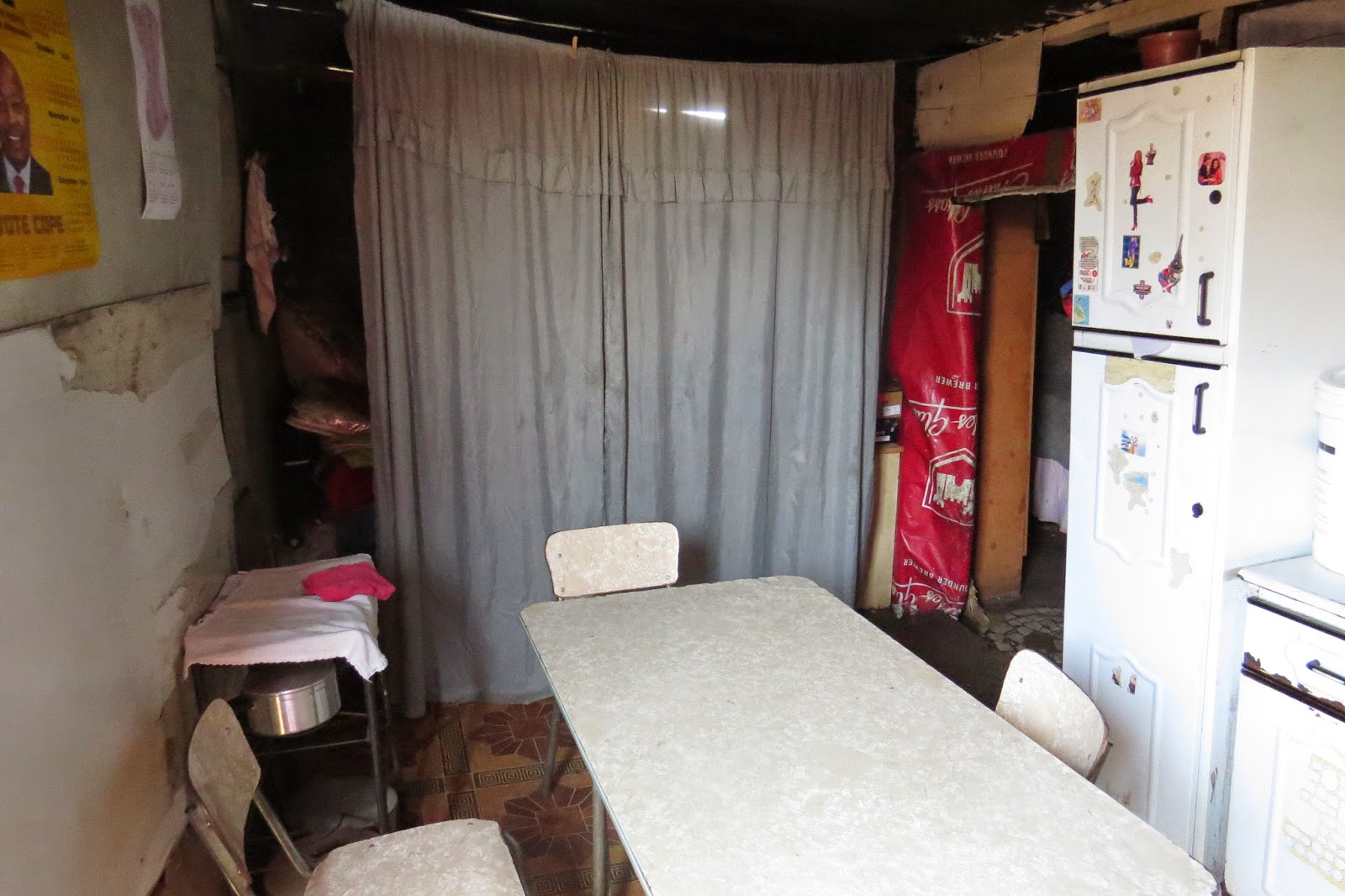
We were able to walk through the township and even visit our tour guide’s home there.  He said there were about 1,000 shanties in this neighborhood and everyone uses ONE tap to obtain water.  The woman in the bright green shirt is using the tap in this photo while the other women are waiting their turn:
And here is the inside of our guide’s home:
As we were leaving the shantytown we saw this guy who was collecting discarded plastic bottles and cans to turn in to the recycling center for a few dollars.  He had amassed all this since the beginning of the day:
One of the last stops on our tour was the Johannesburg cooling towers.  These were part of the old power plant which is no longer in operation.  Instead, they serve as a giant billboard-type advertisement while simultaneously giving thrill seekers the opportunity to bungee jump:

Thursday, February 20, 2014

A Visit to Prison (i.e. Robben Island)

After I checked in to my guest house here in Cape Town yesterday the owner/manager invited me out for dinner after he heard I was a professor of tourism.  We spent most of the time swapping war stories of working in the hotel business, but he also asked me what I intended to do while I was here.  I mentioned I planned to go to Robben Island.  “Why would you want to do that?” he responded.

I guess it never occurred to me to come to Cape Town and then skip Robben Island.  I just assumed it was a requirement.  Do not pass go, do not collect $200: Do not visit Robben Island, do not gain admission to the airport to leave.  So, today I went to Robben Island.

Robben is the Dutch word for seal.  The island was given its name due to the thousands of seals living there.  How many seals did I see today?  Not one.

In order to get to Robben Island you have to take a small ferry about 45 minutes across the harbor.  Once you arrive you are hustled onto buses and shuttled around the island.  Prior to becoming a prison Robben Island was a leper colony.  With the exception of the church, all the buildings from the time of the leper colony were destroyed due to the fear that “the walls may be infected and cause others to contract the disease.”

But we were able to see all the buildings associated with the prison as well as the present day village.  About 130 people live on the island full time, including former prisoners, four former prison guards and their families.  Once the bus tour concludes you are dropped off at the main prison itself.  All the tours of the prison are actually given by former prisoners.  My tour guide, Itumetse, was arrested and sent to Robben Island in 1983; he was released in 1990.

I haven’t really spent much time in prisons, so I’m not really sure what I expected.  There wasn’t very much to see.  Here is one of the watchtowers overlooking the prison yards:
And here is a picture of one of the prison yards where prisoners spent their “free time” when not in their cells:
One of the things I learned during my visit that surprised me was that the prisoners placed a high value on education.  If you look at many of the former prisoners of Robben Island, including Mandela as the most prominent, they are all politicians.  Several are (or previously were) government ministers, the Chief Justice of South Africa, and members of parliament.  I always wondered how this was possible.  While their fame associated with Robben Island may have carried them relatively far in their careers, I expected they had to have some level of intelligence in order to make them able to perform their jobs.  It turns out that Robben Island is what gave them that education.  All prisoners were given access to advanced learning and peer pressure was used to ensure they all participated and took advantage of it.

For the prisoners who were considered “leaders” (Mandela fell into this category) they were sentenced to hard labor, working in the lime quarry.  Initially they were told they would only work there for six months, but in reality the lime quarry was operational for 13 years.  For the first 11 years they were given no protective equipment, which resulted in numerous health problems for many of them.  Most of the prisoners working there had significant damage to their eyes, so much so that most have ineffective tear ducts, meaning they can’t cry, and they cannot stand bright light, so going outside without sunglasses, or having their picture taken with a flash is particularly painful.  The quarry itself doesn’t look impressive, but I’m sure anyone who spent time there found it incredibly memorable:
Naturally, everyone who goes to Robben Island wants to see Nelson Mandela’s cell.  It is one of about 40 identical cells, but there is one aspect which distinguishes it from the others.  As one woman on my tour exclaimed, “Oh look! It’s furnished!”  I’m not sure most of us would consider this “furnished” but apparently this was standard issue for prisoners there:

Tuesday, February 11, 2014

TechAnnounce: The Monkeys are on a Rampage

At Texas Tech, the IT department sends out a daily email to all faculty, students, staff members and anyone else who has an account on the TTU email system.  The email is called TechAnnounce.  Anyone who belongs to TTU can post an announcement so long as it is university related and approved by the TechAnnounce gods.  Today’s TechAnnounce included 58 postings for things such as study abroad courses, opportunities to participate in research studies, a lecture from a visiting scholar, and my personal favorite: Zumba.

University of Botswana has something similar to TechAnnounce.  Nope, let me take that back.  UB has a system in place which is the antithesis of TechAnnounce.   Everyone makes fun of me because I always read TechAnnounce.  Now even more people will make fun of me since I admit I read it every day while living in Africa.  But I do appreciate it because it allows me to keep up with university news and share relevant information in my classes that may be of interest to my students.

Here at UB people use the email system as their personal communication tool.  And EVERYONE uses it.  And they send everything to EVERYONE.  And even worse, they CC EVERYONE and then hit REPLY ALL.  Sometimes we get useful information.  But UBAnnounce tends to be more along the lines of professors sending out posters about the house they are selling or soliciting new clients for their Herbalife business.  Every time someone dies a death announcement is sent out to the entire university.  Often the death announcement is followed up with five dozen emails attempting to organize transportation to the village on the edge of the Khalari Desert for anyone interested in attending.

Today there were two separate UBAnnouncements which struck me as unique, something I would never expect to see back home.  The first was an email from a professor on campus with the subject line: Nelson Mandela’s Will.  The only message was “FYI” along with a scanned copy of Nelson Mandela’s will attached, all 42 pages with signatures and everything.  I don’t know why I need this information, but I will admit I did skim it.  If anyone is interested let me know and I can forward it to you, or write a blog post bullet  pointing who got $300,000, who got $100,000, who got 100,000Rand, and how the homes were divvied up.

The other interesting UBAnnoucement was probably the most useful, but also most unusual email I’ve received since I arrived here.  Subject line: The monkeys are on a rampage.  The email went on to explain that everyone on campus needed to be extra careful to ensure their windows, doors, cars and personal belongings were “secured because the monkeys are on a rampage.” 

Now, I have had my own share of monkey problems, literately.  I absolutely appreciate a heads up that the monkeys are acting out and stealing more than usual.  But when I read that cars needed to be secured it reminded me of the scene from Jurassic Park where the old man owner says that the dinosaurs are so smart they have problem solving capabilities.  Then I flashed back to when the velociraptors were chasing the kids.  The kids hid and one said to the other, “Do you think we are safe?” The other child replied, “Yeah, as long as they don’t figure out how to open doors.”  What happened next? Yup! The velociraptor opened the door!  This made me wonder if the monkeys have learned to open car doors.

To borrow a favorite phrase of my father, here in Africa “I am often amazed but seldom surprised.”  Who knows? Maybe next time I will see the monkeys driving cars they have stolen.  I will keep you posted.
An example of TechAnnounce for anyone interested:


Friday, December 13, 2013

What does Africa REALLY think about Mandela’s Death?

Today I wrote an op-ed article which was featured in The Baltimore Sun newspaper about the perspective of Africans (those not living in South Africa, that is) about Nelson Mandela’s death. Please check out my article by clicking here.

You can also cut and paste the link directly into your browser:

http://www.baltimoresun.com/news/opinion/oped/bs-ed-africa-20131211,0,1291166.story