Showing posts with label Mauritius. Show all posts

Thursday, August 7, 2014

Little America

Last week I was in San Diego for a conference.  When the conference ended I went to San Francisco for a few days to visit my friend Brian.  I had never been to San Fran before, so while my first priority was visiting Brian and his family whom I hadn’t seen in over a year, a close second was checking out the city.  One of our excursions took us to Chinatown, which is the largest Chinatown outside of Asia, and the oldest in North America.  The funny thing about all that stuff being sold in Chinatown… is that it is all made in India!  I took great pleasure in picking up all the little trinkets, turning them over, anticipating a “Made in China” tag, only to be shocked upon reading, “Made in India” instead.  What IS the world coming to?

Somewhere between the fortune cookie factories, the foot reflexology massage advertisements and the Indian made chopsticks, I was reminded of a conversation I had with some friends about a similar phenomenon... Little America.

Believe it or not, Africa is not typically known for being culinarily sophisticated or diverse, but there is evidence to the contrary.  There are at least three established Chinatowns on the continent, in Madagascar, Mauritius and South Africa; Mombasa, Kenya hosts a huge annual Oktoberfest; and Johannesburg has a Little Italy.   One afternoon I was sitting in the lounge at Joburg Airport with some recently acquired single serving friends discussing these types of ethnically-centered communities.  A Brit made the comment (in the way only a Brit could say it), “I don’t understand, why aren’t there any Little Americas?”  To which I responded (as only an American could), “Of course there are!  In fact there are several thousand of them.”  After a belated pause for effect and the expected exchange of confused glances I continued, “And you have all been there, likely many times.  It is called McDonald’s!”

The mention of McDonald’s sent the conversation off on a completely different tangent, one in which only a tourism professor could dominate, and so I did.  My companions began debating the merits of McDonald’s, the menus selected according to geographical region and questioned why some countries have a never-ending supply of McDonald’s, while other areas, particularly the large majority of Africa were McDonald’s-free zones.  Even the Brit admitted, “The last four months in Zimbabwe have been the longest of my life.  I would have killed for a Big Mac.”  There are only five African countries with McDonald’s restaurants: Morocco, Egypt, South Africa, Mauritius and Reunion Island.  The other 49 countries are sans-Mickey-D’s.  In case you are curious as to why McDonald’s has not infiltrated the continent there is a simple answer: The Golden Arches Theory of Conflict Prevention.

In 1999 Thomas Friedman wrote the book The Lexus and the Olive Tree in which he stated, “No two countries that both had McDonald’s had fought a war against each other since each got its McDonald’s.”  In the Golden Arches Theory of Conflict Prevention chapter, Friedman goes on to explain that McDonald’s will only enter a country that has reached a certain level of economic development, one which supports a middle class that can patronize a McDonald’s establishment.  Once a country has that kind of financial security it becomes a “McDonald’s country,” one which is stable enough not to want to pursue potentially destructive actions, such as wars.

In all fairness, The Golden Arches Theory is not absolute.  In fact, shortly after the book was published NATO bombed Yugoslavia.  The 2006 war between Israel and Lebanon and the current crisis with Russia and Ukraine are other examples which make the theory flawed.  But at the same time, there are countries which could be categorized as possible “McDonald’s countries” which haven’t made the cut.  Namibia and Botswana haven’t been in wars with anyone since independence, 24 years and 48 years, respectively.

Trust me, I am NOT advocating the spread of McDonald’s, particularly into Africa.  I would much rather see these countries develop their own businesses outside of the big brand giants.  But I have to admit, there is nothing more challenging than teaching in Botswana and saying to your class of 100+ students, “Ok, you know how McDonald’s does XYZ?”  You look into the crowd of faces and realize everyone is staring back at you completely clueless as to what you are talking about.  “No, no most definitely do not know how McDonald’s does XYZ, or anything for that matter.  Never mind, give me a second, I can find another example for you.”  At some point in your academic career you think you are pretty well versed in your field.  And then you get a little reality check like this one and remember that learning should never stop.

Here is a map of countries with and without McDonald’s, along with some other interesting facts.  It should be noted there is a mistake on this map: the large red spot in northwest (top left side) Africa is Algeria which does NOT have a McDonald’s.  Instead that should be blue and there should be a red area NEXT to it (on the left) where Morocco lies.  Minor detail, unless of course you are Moroccan or Algerian:

Saturday, June 28, 2014

The Poverty-Weather-Suicide Correlation

I’m enjoying the conference I’m currently attending because there are people here from all over.  Aside from me there are only two Americans, but there is a large contingent from Europe and Africa.  Since I am a bit unusual as I haven’t left Africa for the past year a number of people have approached me and asked a variety of questions about my time here on the continent.  Today I had a conversation with someone about poverty in Africa.  I told her that most government officials in Africa regard poverty as being out of their control, something they simply can’t change.  Just like they can’t predict or influence the weather, they can’t influence or change the occurrence of poverty.

Botswana is considered an upper middle income economy, but according to the World Bank 32.9% of the population still lives below the national poverty level.  Of course, Botswana is the wealthiest country in sub-Saharan Africa.  I know I’ve mentioned some of the unemployment issues in countries like Nigeria (54.7% of the population lives in poverty) and Zimbabwe (72% poverty), that Lesotho (56.6% poverty) used to be so poor that one of their primary exports was human blood, and that Congo (71.3% poverty) is so unfortunate they can’t afford to eat the cassava and instead they eat the leaves from the plant.  Poverty alleviation is a huge key term which you hear all over the place.  But the truth is most African leaders don’t think poverty can be cured, so they don’t really sweat it.

It should be noted that poverty alleviation is different from economic growth.  I have a friend who works for the World Bank.  His job is to identify aspiring entrepreneurs, give them micro loans- typically $1,000 or less- in an effort to get them to improve their socioeconomic status.  He can’t GIVE this money away!  He told me about a conversation he had with a fisherman.  The fisherman said he caught three fish each day and then sold them; that would meet his needs.  Mr. World Bank explained he would loan him money to buy a new boat, or new nets, or whatever he needed to improve his business so he could catch more fish.  The fisherman’s response: “I don’t need to catch more fish.” Mr. WB explained if the fisherman caught more fish he could send his son to university, or have the money if his wife got sick, or maybe just buy some milk for his family.  The fisherman said he didn’t need money in case those things happened.  He said when his wife got sick he would just catch five or six fish that day to buy her medicine or pay the doctor.

The reason the fisherman in the story didn’t want to earn extra money is because he would never get to save that money, so it was pointless.  The challenge with elevating Africa out of poverty and improving standards of living is because the culture here does not encourage future planning.  Family ties are important and everything is communal.  This means if the fisherman catches 10 fish and suddenly has more money his aunt in the village will show up and ask for the money to pay her medical bills.  If he catches 20 fish he won’t see any profit from that either because his distant cousin in the next village will ask for the money to pay the bride price for her son’s upcoming marriage.  If he catches 50 fish then the niece of his neighbor’s granddaughter in the country next door will show up on his doorstep asking for a loan to pay for her father’s funeral announcement.  And the cycle continues and never ends.

As I continued my conversation with the woman at the conference today she asked me how Africans are able to withstand so much poverty, violence, government instability, persecution, disease and everything else they put up with.  Just last night I finished the book David and Goliath by Malcolm Gladwell.  In his book, Gladwell states that happiness is measured on a sliding scale in relation to one’s peers.  He states that Switzerland has the happiest people in the world.  However, Switzerland also has one of the highest suicide rates.  By contrast, Africans are significantly less happy because of all the challenges associated with living here, but since everyone else here is miserable (at least in terms of material possessions, wealth, etc.) the suicide rate is very low because they can’t look at others and be envious since everyone is in the same (sad) boat.

Friday, June 27, 2014

Presidential Protocol

If you’ve been following my blog for a while and read my posting back in December about How to Make a Speech (in Africa) then you probably already know where I’m going with this title.  If you missed that blog you can read it here.

As I mentioned yesterday I am here in Mauritius for the Advances in Hospitality and Tourism Marketing and Management Conference.  The fun thing about going to conferences in Africa is that the organizers take them very seriously, so they often bring high ranking public officials to be keynote speakers or guests of honor in order to show attendees how much the country values the topic of the event.  For instance, at the opening session of the conference today the President of Mauritius was the keynote speaker.  In the past year I have seen President Khama of Botswana, President Mugabe of Zimbabwe, President Sata of Zambia and now President Purryag of Mauritius at conferences.  In the last 35 years I have NOT seen Presidents Carter, Reagan, Clinton or Obama.  I did have breakfast with former President Bush Sr. when he was a speaker at an event I did in Vegas and while I didn’t meet W. (George W. Bush) I did ride in his limo when he did an event of mine while I was working at Disney- though that was before he became prez.  To put this in perspective, I have a 100% presidential citing average at conferences in Africa.  Considering the fact I have probably organized at least 500 events over the years that means I have seen presidents at 0.004% of my events in the U.S.

Of course, having a president, or any well-known public servant attend an event here calls for protocol.  First there is a red carpet.  I didn’t take a picture of today’s red carpet because it wasn’t one of the nicer red carpets I’ve seen in the last 12 months.  But, you can see Mugabe’s red carpet here if you like.  Of course, before the official of note shows up there is the corralling of all the staff at the hotel, as well as the entourage.  Mugabe travels with a presidential escort of 60 vehicles and hundreds of personal guards and staff.  I didn’t witness the line of all the hotel employees standing outside the hotel for inspection upon arrival by President Purryag today, but I know it happened based on reports by other conference attendees.

Once the official arrives there is the playing of the national anthem, then the seating ceremony.  Now, up until this point I follow along like a well behaved guest.  I only reveal my true colors once the speeches begin.  And today was no exception to the rule.  Each time someone spent five minutes saying hello to all the honored delegates and then stated, “Protocol observed” it was all I could do not to burst into laughter. Again, if you don’t know what I’m talking about with the “protocol observed” you REALLY need to read this blog post.

All in all the visit from President Purryag was positive.  He had a lot of good comments regarding tourism in Mauritius and Africa as a whole.  Plus, it was fun to have one final reminder about protocol and speeches before I head home.  Thanks for the memory President Purryag!

Thursday, June 26, 2014

Mauritius, Not Madagascar

As I am writing this I am sitting in bed in my hotel room watching the television show, The Good Wife, which is dubbed over in French.  For the past year I have been travelling around Africa and each time I’ve checked into a hotel I have hoped for two things: 1. air conditioning and 2. television.  This is the first time I’ve had both and naturally, now that my prayers have been answered I am no longer interested.  I’m at a beautiful beach resort in Mauritius for a conference and it just seems wrong to be using the air con or watching tv.  In order to help you understand why air con and television is criminal here (and to make you a teeny bit jealous) here is my hotel room:
And this is the view from my balcony:
I arrived in Mauritius yesterday and my conference started late this afternoon.  If you haven’t heard of Mauritius before, that’s ok, very few people have.  But, given the fame of the Disney film, Madagascar, I’m sure you have heard of Madagascar.  Well, Madagascar is not Mauritius.  But they are neighbors.  Madagascar is a very large island located off the south-eastern coast of Africa in the Indian Ocean.  Mauritius, Reunion Island and Rodrigues are three very small islands east of Madagascar.  That brings us to the end of today’s Geography lesson. Any questions?
Mauritius was invaded/ruled/colonized by all the major players in Africa: first the Arabs in the 10th century, then the Portuguese, the Dutch, the French and finally the British.  Due to its location in the Indian Ocean, Mauritius was a major stopover point between Europe and the East, causing a significant influx of immigrants.  Today 70% of the island’s 1.2 million people are Indian with Chinese, Africans, and Europeans making up the remaining 30%.  So far I have only seen Indians here.

I’m looking forward to my conference as there are a lot of researchers and presenters here from across Africa.  Plus it’s nice to have a good excuse to visit Mauritius as it is a very popular, high end tourism destination here in Africa.  Weddings and honeymooners are the primary tourism target market here.  And I can see why.  Here is the view from my breakfast table:
And the view from my seat on the beach this morning:
And the lobby of the hotel:
It’s kind of a waste to come here alone.  It reminds me of Hawaii, though not as humid.  In a way it is almost a terrible place to come for a conference because once you see the views all you want to do is sit on the beach.  But then again, I would have never come here if it weren’t for my conference.  Nevertheless, I enjoyed my beach time today and am looking forward to starting work tomorrow.

Tuesday, February 18, 2014

A Very Busy Few Months Ahead

One of the interesting aspects of being a Fulbrighter is that you are given a lot of freedom.  As long as you are fulfilling your obligations to your host institution it is up to you how you spend the rest of your time.  There are no hard and fast rules in terms of what you are expected to accomplish, which is a good thing as red-tape and politics can make some objectives much more difficult than others.
Last year before I came to Botswana I contacted another Fulbright Scholar.  I asked about the process you had to go through in order to get permission to do research.  She informed me it was much more arduous than in the U.S. and that while she had applied for a research permit in August it wasn’t granted until May.  She left in June.

Fortunately for me I didn’t have nearly as difficult of a time obtaining my permit and IRB approval to conduct my research.  But a lot of that is pure luck; catching the right person who actually knows the answer to your question on a day when they are happy and willing to help you. 

Over the past seven months I have been busy teaching, doing research and travelling.  Most of my travel has been work related for data collection or serving as a guest speaker at other universities, though some of it has been for fun as well.  Since I arrived back from Christmas I’ve had several tourism colleagues throughout the continent invite me to visit them at their universities to guest lecture for a few days.  In order to juggle all the requests, along with other side trips I wanted to take before I left I decided to sit down and plan out the next six months.  Thank goodness I did otherwise I would have never been able to squeeze in another commitment.  This is my calendar for the next six months.  All of the shaded blocks are when I am travelling:
To give you a rundown here is what is on my calendar:

Tomorrow: Head to Cape Town, South Africa for three days to teach at Stellenbosch University.
March: Johannesburg for three days to obtain my DRC visa and visit a colleague at Vaal University with whom I am writing an article.  Then on to Lesotho to visit some of our students currently there on internship.  From Lesotho, go to Mozambique to meet a fellow Fulbrighter for some fun. (This trip takes place during our mid-semester break.)
First week of April: Zanzibar, Tanzania to meet an Egyptian friend who lives in Nairobi, Kenya to hang out on the beach for a long weekend.
Middle-Late April: Fly to Kigali, Rwanda to teach at the Rwanda Tourism University College.  From there head to Goma, Democratic Republic of Congo to teach at University of Goma and then climb the volcano over the weekend.  On the way home stop in Addis Ababa, Ethiopia for three days to give Ethiopia a chance to redeem itself after the luggage fiasco.
May: Amanda and Ashleigh come to visit me in Botswana!  Finally, I get to play host to friends from home.
June: Back to Tanzania to climb Mt. Kilimanjaro.  Then Dad comes to visit for 10 days and I get to show him around Botswana.  The day Dad departs I go to Mauritius where I am presenting two papers at a conference.
July: Perhaps return to the U.S.? 

I would have to say if nothing else I have certainly taken full advantage of my time here.  And I think Fulbright has also gotten its money’s worth. I may have to give my passport a rest whenever I finally make it back across the ocean.

Saturday, November 23, 2013

Why don’t Africans ride bikes?

In Botswana I am the only person I know who rides a bike.  I don’t believe I’ve seen a single other person riding a bike since I moved there.  Of course, riding a bike in Gaborone is really taking your life in your hands because the drivers act as if they are racing in Formula One, while simultaneously competing in the slalom event at the Olympics as they duck in and out of tiny spaces between cars, and growling the entire way.  Batswana are very friendly people, and never really in a rush.  But put them behind the wheel of a car and suddenly it’s the running of the bulls- they are angry and moving like there is no tomorrow.

Here in Uganda I haven’t seen anyone riding a bike either.  However, it is important to note the emphasis in that last sentence was on the word riding.  I haven’t seen anyone riding a bike here.  Of course, I’ve seen tons of bikes.  Being pushed.  No, people don’t ride bikes here, they push them.  But, let’s be clear, they don’t push them for fun, they actually have a reason to push them.  Typically the bikes are heavily laden with giant loads of stuff.  That stuff ranges from multiple banana plants, plastic crates filled with glass soda bottles or even building materials.  Hauling is what bikes are used for in this region, not recreation.  Of course, when I see this I tend to wonder why a wheelbarrow or dolly or even a stroller might not be more efficient, but I haven’t taken these musings any further.

Today I found out why people push bicycles instead of riding them.  Because riding them is grueling.  You know in the movies about Africa when you see those dirt roads with rolling hills and banana trees growing along the side?  Those romantic dirt hills might as well be mountains.  Since they aren’t tarred there are a lot of loose rocks you battle, along with the mud from the rainy season which we are currently in the midst of.  All the while children are emerging from their houses to wave, shouting, “Hello muzungu (white person)” as you are huffing and puffing, praying you will make it up the hill without passing out or falling over.  The good news is, apparently my Mt. Kilimanjaro training has paid off.  My tour guide told me he almost never makes it the whole way through a tour without someone having to dismount and walk their bike up a hill.

After four hours navigating through Kampala, I finished my ride covered head to foot in dirt and exhausted, but very happy.  The ride itself was great and it was fun to see the city from another angle.  As part of the tour we visited a primary school.  It was probably the smallest school I had ever seen and was responsible for educating nearly 800 students.  The thing I liked the most about the school was the fact there was a poster of African leaders in one of the classrooms.  Take a look at the picture and then tell me which one doesn’t belong:

If it didn’t strike you right a way here’s a hint: Look in the top left hand corner. Was anyone else out there surprised to find out Barack Obama, President of the United States, is considered an Africa leader?  I know, shocked me as well.

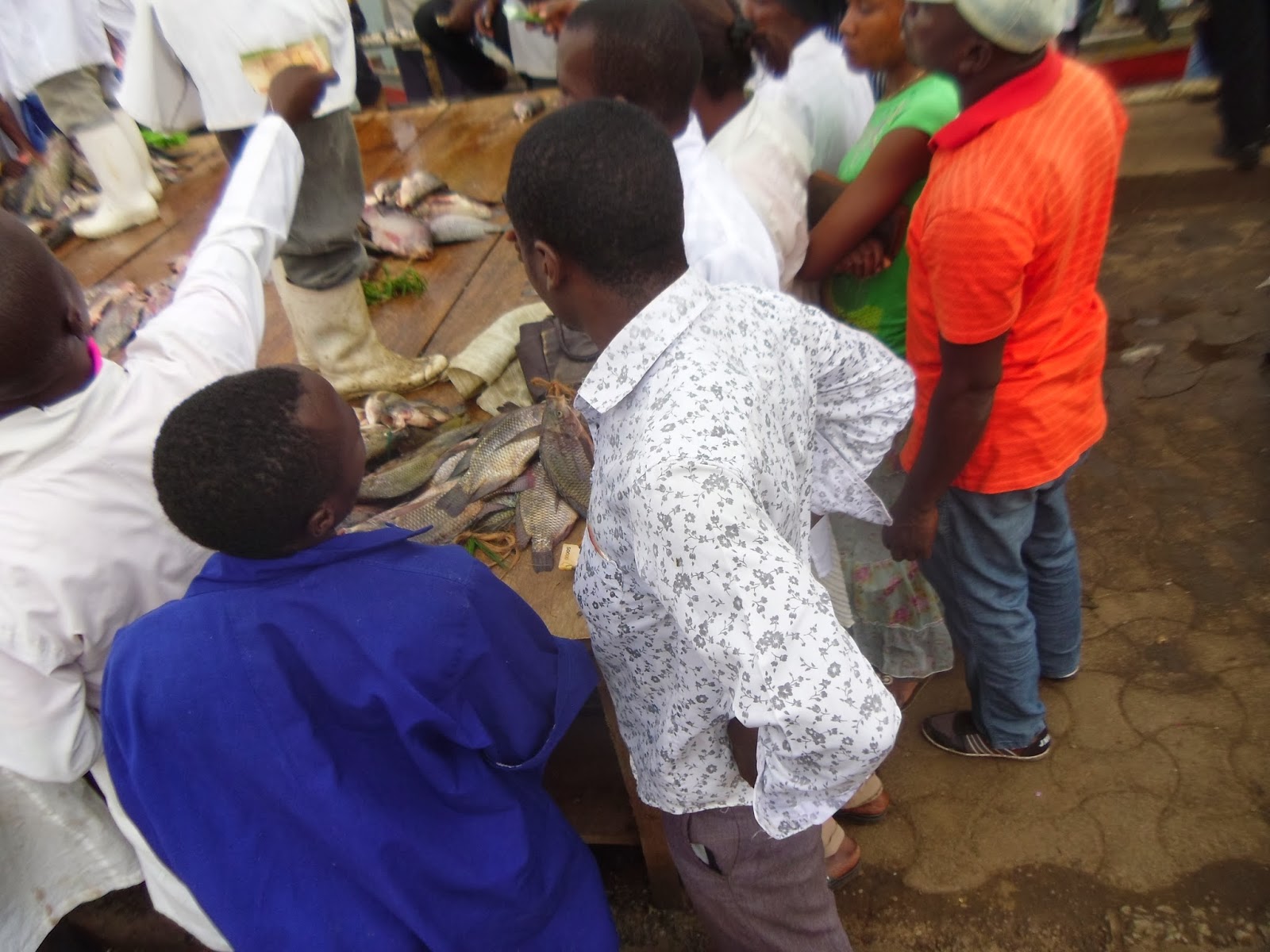
We also went to the fish market where I got to see them auctioning off live fish:

As well as cleaning and preparing fish:

I also got to try jackfruit. Jackfruit is found in some parts of Southeast Asia, but it is also in Uganda, Tanzania, Cameroon and Mauritius.  It takes similar to a pineapple, but not as sweet.  I love pineapple, but I think if given a choice I would opt for the jackfruit:

Since Kampala is huge I couldn’t see the entire thing by bike.  At the market I got to see lots of women cleaning grasshoppers before frying them.  Here are some “cleaned,” pre-fried grasshoppers:

Then we ended the tour by taking a boat across Lake Victoria:

Overall it was a great tour and I’m glad I did it. Of course, next time I might take the time to think about the logistical feasibility before I commit to something like this.  Ok, who am I kidding?  No, I probably won’t.  I’ll just go and have fun away.  Speaking of which, tomorrow I’m doing a boda boda tour.  Fingers crossed that goes off without a hitch.